I'll be taking the American Labor Day weekend off from producing programs. There will be no Saturday Afternoon with Carolyn on August 30th and no The Heretics' Hour on Monday, Sept. 1st.
Hitler's Table Talk will continue uninterrupted on Thursday. Thanks for your loyal listening.
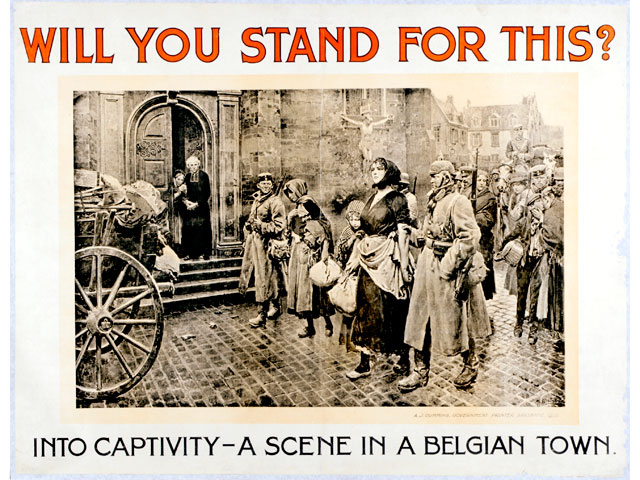
Propaganda poster combining photography and drawing to emphasize religious symbology that projects the German soldier as the persecutor and despoiler of Christian women.
Continuing with the theme of the 100th Anniversary of World War I (1914-2014), Carolyn Yeager focuses on the transparancy of the accusations of barbarism and drunkenness on the part of the German soldier in Belgium. In the second hour, who is telling the most lies in the current Ukraine war is discussed. Highlights include:
Most of the stories recounting atrocities are by nameless people, and were later rebuked as false by authorities;
Gottlieb von Jagow, German minister of State, wrote that the fire broke out after explosion of a convoy of benzine, which was caused by shots fired during the battle with the illegal civilian shooters;
Photograph fakery, both in the form of false captions and in the more sinister creation of fake scenes, events, etc. are much more common than people realize - some examples given;
The suppression and/or ommision of parts of the content of diplomatic reports and/or telegram messages was common;
Of the nations, Russia was the most extreme in lying, followed by France;
The pro-Russian separatists in eastern Ukraine and the Putin govt. are using lies as a strategy, meaning they have no shame about it and don't really expect to be believed;
Bill Finck writes an article in which he compares the situation in today's Russia with the United States in the 1950's, when the undermining of the White majority began.
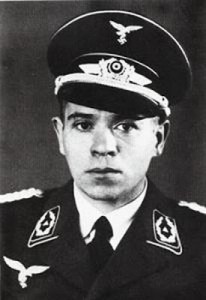
Carolyn Yeager looks at two outstanding Germans named Manfred Roeder: the military judge who prosecuted the "Red Orchestra" traitors in 1942-43, and the patriotic activist called the Federal Republic's "most dangerous and notorious critic" who died on July 30th at age 85.
Prof. Ulrich Keller says German troops faced sniper fire from Belgian partisans (francs-tireurs) in the city of Louvain in WW1, and the evidence is found in 150 sworn statements from investigations and court records;
The younger Manfred Roeder fought in the Battle of Berlin at age 15-16, and continued the battle for a true constitutional Germany free of US/Jewish domination for the rest of his life;
Roeder was sentenced to prison twice (for 13 yrs and 2.5 yrs) for arson attacks and Volksverhetzung - incitement to hatred and insult;
The death sentences sought and gained by Roeder the military jurist were all upheld on appeal after the war as being conducted in accordance with the law;
The older Roeder was fully accepted in German society postwar, being an active member of the CDU, even though he had served and been admired by Hitler and Goering.
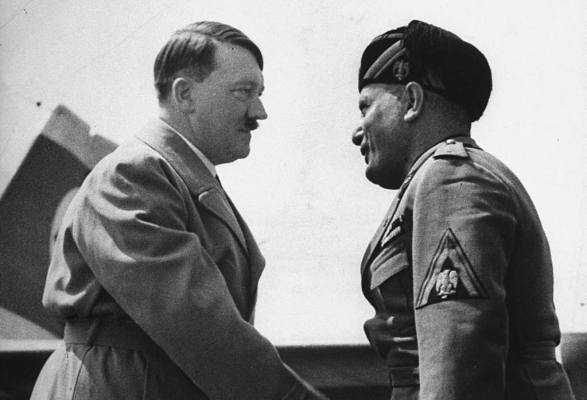
Hitler and Mussolini's expressions reveal the warmth and trust between them as the Führer arrives in Rome for a week-long state visit in May 1938.
Ray Goodwin and Carolyn Yeager read and comment on the Jan. 28-Feb. 2, 1942 dinner table monologues by the German Leader, as taken down in shorthand by trusted aide, attorney Heinrich Heim. Included in this episode:
The importance of large families and the rights of growing populations;
Recollections of prison days and how to handle the Czechs;
Long discussion on his friendship with the Duce, Italian Fascism and the "fossils" of the Italian Court;
Hitler describes his early political opponents, plus his experiences with the police and with procuring weapons;
Tells some amusing stories about French Ambassador to Germany, Andre-Francois-Poncet;
Hitler criticizes his diplomats and questions how to reorganize German diplomacy.
The edition of Hitler's Table Talk being used was translated by Norman Cameron and R.H. Stevens, published by Enigma Books, New York, and can be found as a pdf here
This is a translation of the Korherr Report in full posted by "Roberto" at the Axis History Forum. You can check it against the German original, which is also linked to. I have highlighted the parts most under discussion/debate in blue. ~CY
A document often referred to on this forum, the Korherr Report should, in my opinion, be available online for consultation by all interested readers.
The report was prepared in two versions, a “long version” for Himmler and a “short version” for the Führer himself. The original German wording of both versions is transcribed under the following links: http://www.ns-archiv.de/verfolgung/korherr/korherr-lang.php (“long version”)
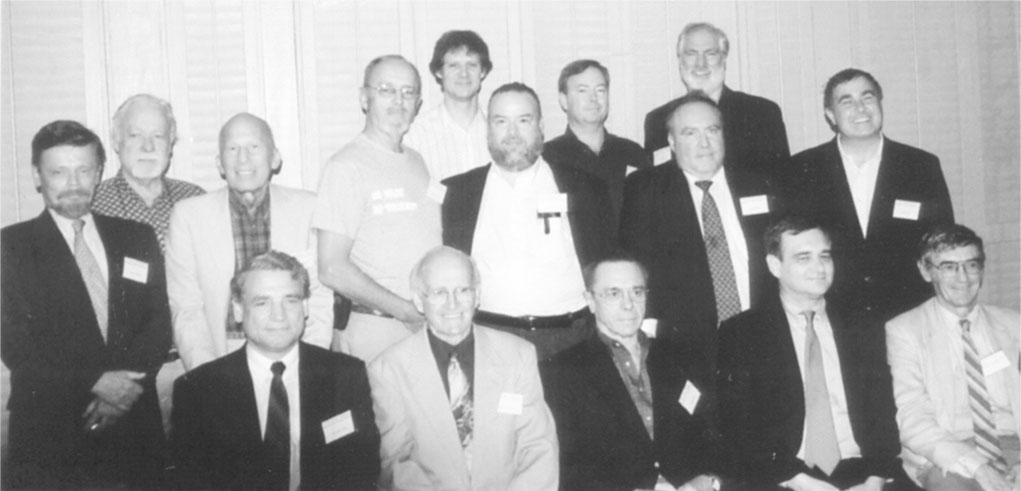
These are the speakers at the 13th IHR Conference in May, 2000. Standing (left to right): Glayde Whitney, Bradley Smith, John Sack, Robert Countess, Germar Rudolf, Charles Provan, Theodore O'Keefe, Ernst Zündel, Greg Raven and Jürgen Graf. Seated (left to right): Fredrick Toben, Robert Faurisson, Arthur Butz, Mark Weber and John Bennett. Not shown here are (former congressman) Pete McCloskey and David Irving. Of these, David Cole has now made major criticisms of Smith, Zündel, Graf, Faurisson and Toben, in addition to Carlo Mattogno.
Carolyn Yeager deconstructs the complaints David Cole levels against the better-known revisionists, and at the same time comments on the character of the Jew and their experience during the two World Wars.
The myth that every life is precious and irreplaceable does not fit with the way Nature works;
Traits of the alcoholic;
Cole's caustic disrespect, put-downs, and noxious attitude toward the revisionist community is so extreme it raises questions;
Cole's 1995 16-page letter of his Strufhof camp visit and his accusations against Robt. Faurisson;
It doesn't seem possible that an answer will ever be found to what happened to the majority of unknown Jews who make up the numbers in the "Korherr Report";
The story of "gas chambers" is brought forth to answer every question of missing Jews;
All Germans know that Jews are their deadly enemy and politically dangerous, even Wilhelm II, Germany's last Kaiser.
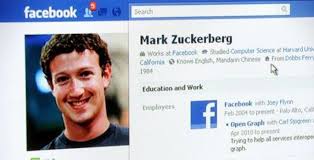
Screen shot of Mark Zuckerberg, creator of Facebook and young multi-billionaire who is in a mixed-race marriage.
Carolyn Yeager discusses a number of subjects, beginning with Dr. Rudolf Frercks "Racial Policy of National-Socialism" and how it impacts on what we're experiencing today. Other topics are:
Consorting with the enemy, as with Facebook, Youtube, Hollywood, major league sports;
Carolyn Yeager and Ray Goodwin read and comment on the January 25-28th, 1942 dinner table monologues by the German Leader, as taken down by trusted aide, attorney Heinrich Heim. Included in this episode:
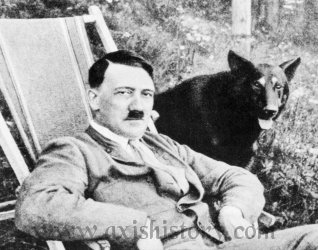
Hitler speaks of his love of dogs, human origins, beauty of ancient Greeks, cosmic theories, his preference for art over politics;
Women should not be in politics - Men run the state, women run the home;
Foreign blood in war - the social caste system in Britain needs changing - National-Socialism encourages the selection of the fittest;
Difficulties in getting hold of the German economy - negotiating with adversaries - Jews must leave Europe.
The edition of Hitler's Table Talk being used was translated by Norman Cameron and R.H. Stevens, published by Enigma Books, New York, and can be found as a pdf here
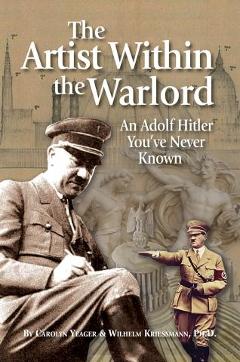
Translated and condensed from Hermann Giesler's Ein Anderer Hitler by Wilhelm Kriessmann and Carolyn Yeager
This is a condensation of the 15-page section Der Zwist on pages 340-355
copyright 2014 Carolyn Yeager
“ Powerful and at the same time not interested in power” … so judges the American historian, Professor Eugene Davidson, about the author Adalbert Speer, when reviewing his book Erinnerungen.
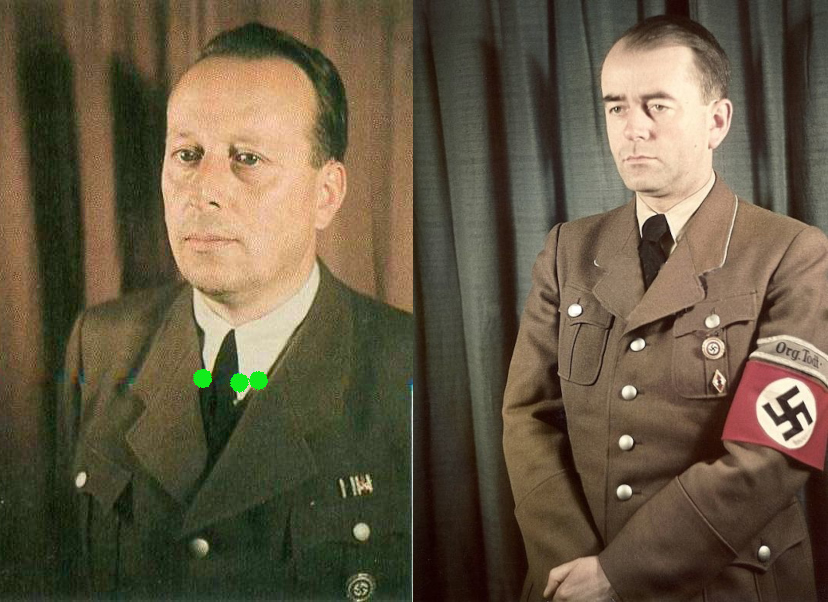
The following footnote (Chapt. 4, #32) from Joachim Fest’s Speer: The Final Verdict reveals the disdain Albert Speer felt toward Hermann Giesler that was probably the root of the problems between the two men.
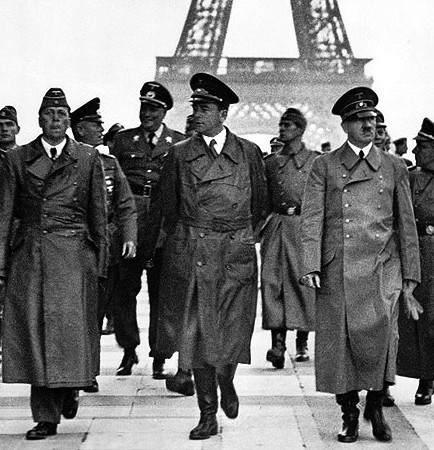
“… in the caption to the picture showing Hitler in front of the Eiffel Tower, (Speer) mentions Breker but not Giesler on his right. […] In conversation Speer remarked that Giesler had been distinguished “beyond merit” by Hitler's invitation. Asked if he had been jealous of his rival, he replied, ‘How should I have been jealous of him? Giesler was a frightful petit-bourgeois! How could he supplant me in Hitler's favor?’ […] How unremitting Speer’s feelings were for Giesler emerges also from the fact that he consistently misspells his name with what seems like pointed indifference.”
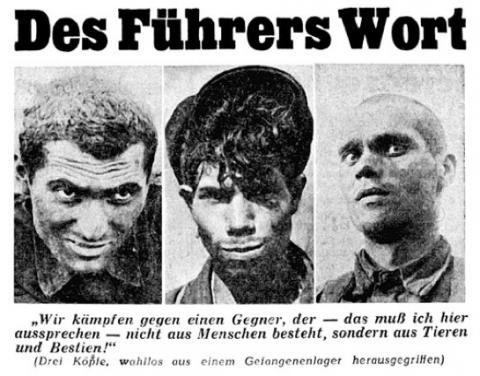
Photographer unknown (German). "The Führer’s Word," 12-Uhr-Blatt, October 9, 1941. The caption below these images of Soviet prisoners of war reads, "We are fighting against an enemy that – and I have to say it here – consists not of human beings, but of animals and beasts!"
Such photographs – often featuring three figures, as in TASS 60 – appeared in the daily and weekly German press accompanied by captions that further underscored the inferiority of people with Asiatic, Semitic, and Slavic features.


 by
by