



By Carolyn Yeager and Wilhelm Kriessmann
copyright 2009 Carolyn Yeager
 You are the greatest and most courageous soldier the German people have ever had."
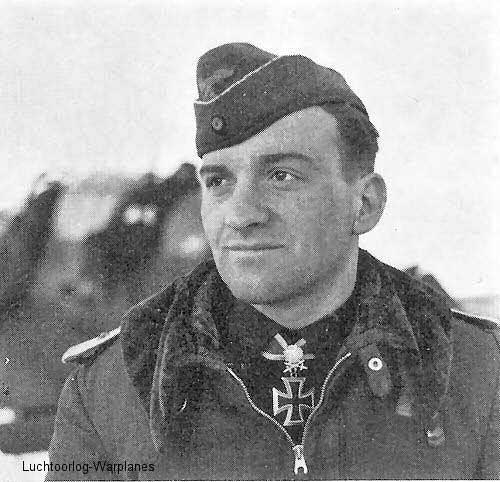
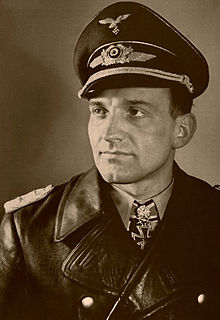
So Adolf Hitler told Hans-Ulrich Rudel on January 1, 1945 at the bunker headquarters in Berlin on the occasion of promoting Rudel to the rank of colonel and awarding him the highest German WWII decoration: the Knight's Cross with Golden Oak Leaves with swords and diamonds.1
This was quite a statement considering all the great and courageous soldiers that have fought so valiantly for the Fatherland, yet considering the almost unbelievable accomplishments of this modest man who loved piloting and sports, it was not a rash statement.
Rudel's extraordinary career began after he overcame a childish timidity by plunging himself into sports participation after hearing mocking words from his older sister. Once he had conquered his fear, "no tree was too high, no ski slope too steep, no brook too wide, and no boy's prank too risky" 2 for this son of a Lutheran priest who weighed less than six pounds when he was born July 2, 1916 in Konradswaldau in German Silesia - which since WWII is the section of Poland bordering the Czech Republic.
He developed the conviction that "one can do anything if one wants to." As a soldier, he famously maintained this belief with his personal motto: "Only he who gives up on himself is lost."
Between the Hitler Youth and school sporting meets, "Uli" became a decathlete for whom an Olympic future was predicted. From childhood he had wanted to become a pilot, but after he matriculated from secondary school his father could not afford the expensive training, as his oldest sister was already studying medicine.3
When he learned of the formation of a new Luftwaffe, he determined, "I will become a pilot!" He passed the difficult entrance examination and began infantry training in Dec. 1936, but his path to becoming the world's greatest pilot was plagued with disappointment. First, he was a slow learner. After volunteering for dive bomber school, he couldn't seem to get the hang of Stuka flying. And he was an odd duck, eschewing mess life with the other cadets [he didn't drink or smoke] to spend all his spare moments at sports or hiking in the magnificent hills surrounding Graz, in Styria.
Much to his dismay, he was transferred to reconnaissance flying school and during the Polish campaign the only shots he took were with a camera. He was also present, but not allowed to fly, during the Western campaign. Then in September 1940, he was sent back to Graz to a Stuka Replacement Gruppe and on a practice mission he suddenly sensed what had so far eluded him and, even more, he had the clear knowing "now I have got it, now I can make the machine do everything I want it to."4
THE WARRIOR EMERGES
From then on, no one could touch him for skill and precision bombing; he was master of his machine. After Easter 1941, he was posted, with high hopes, to I. Gruppe of Stukageschwader 2 Immelmann on the Greek peninsula, but the CO there refused to allow him to fly operational missions, based on old reports from his adjutant. It wasn't until his Group was transferred to the air base at Raczki on the Eastern Front that Rudel was finally given the chance to show what he was capable of.
On Sept. 23, 1941, his first extraordinary action took place. He sank the Soviet battleship "Marat" at the harbor of Kronstadt. By making a steep, up to 90 degree dive, he released the 2000kg bomb at about 300 meters, apparently striking right into the ship's magazine, and skyrocketed straight up into the air, barely avoiding tremendous anti-aircraft shell fire and the explosion itself. He heard his gunner say, "Herr Oberleutnant, the ship is blowing up!" Congratulations immediately began pouring in from all sides over his radio.
He followed by sinking a cruiser, a destroyer and numerous landing boats around Kronstadt and the Lake Ladoga area. By the end of the war, Rudel had logged an unmatched 2,530 missions. In his first ninety days of flying against the enemy, he made his 500th flight and received the German Cross in Gold. In January 1942, General der Flieger von Richthofen presented Rudel with the Knight's Cross in the name of the Fuehrer, the citation listing his successes against ships, direct hits on important bridges, supply routes, artillery positions and tanks.
During 1942, Rudel's Gruppe flew difficult missions over the Caucasus, directed to their targets by radio. They sealed up a Russian armored train in a mountain tunnel, destroyed harbor installations, airfields, and vessels on the Black Sea. At the end of '42, they flew missions in support of the heroic defense by the surrounded 6th Army at Stalingrad.
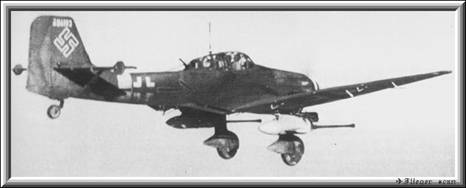
In 1943, following his 1,001st mission, Rudel went to a special unit at Rechlin/Mecklenburg that was testing the new anti-tank Ju 87 armed with two 3.7 cm. cannon carried beneath the wings. Flying such an unwieldy but fearsome "cannon bird", Rudel went on to destroy more than 519 Russian tanks by the end of the war.
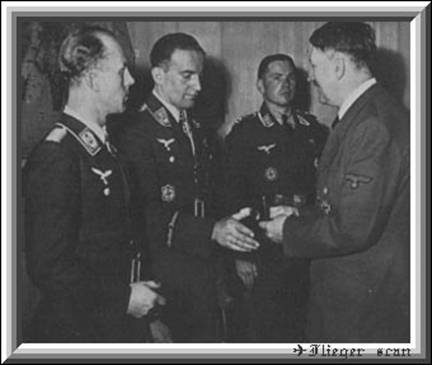
In April '43, Rudel was promoted to Hauptmann and received the Oak Leaves to the Knight's Cross from Adolf Hitler in the Reich Chancellery, along with 12 others receiving decorations. At this time, Hitler must have already been observing him closely.
PERILOUS FORTUNE
A noted characteristic of Hans Rudel was his unwillingness to stay out of action, even when ill or injured. His healthy lifestyle - which included his continuing regimen of sports and mountain climbing in his spare time - and his positive mental attitude made for a constitution that mended rapidly. He "escaped" from several hospitals before being formally discharged and returned to his group, finishing his recovery while flying again.
Rudel was not immune, however, to the dangers he and his squadron faced daily. His plane was shot down by ground fire or crash-landed over 30 times, but he always managed to return safely. He even landed behind the Russian lines six times to rescue pilot comrades. On the last such occasion, in March 1944, he landed near the destroyed Dnjester bridge to pick up the two-man crew of a crash-landed Ju 87. As it turned out, the field was so muddy he could not take off again and they were forced to escape by swimming across the icy-cold river. Rudel was the only one of the group to survive, even though he swam back into the river in an effort to assist his floundering gunner, whom, however, he could not save. The other two pilots didn't run, as Rudel did, when they were approached on the other side by Russians who took their pistols. He was shot in the shoulder as he zig-zagged away, and ran/jogged nearly 30 miles, barefoot, over hard, rocky ground, chased by pursuers with dogs, until he reached the German line.
Following this ordeal, his feet were so damaged he couldn't wear regulation shoes or boots for several weeks while he continued flying missions and, in fact, appeared at the Berghof on March 29th as the tenth German soldier to be awarded the Knight's Cross with Oak Leaves, Swords and Diamonds from Adolf Hitler, the highest existing decoration at that time, wearing his fur-lined flying boots.
Rudel was recognized by everyone as a phenomenon - a soldier who stepped beyond the limits of fortitude and sacrifice, and took risks nobody else dared. But he could not escape the perils forever. In November 1944, he was badly wounded in the thigh but, after an operation and with his left leg in a plaster cast, he continued flying. It was January 1, 1945, on the occasion of Rudel becoming the first and only German to be awarded the Knight's Cross with Golden Oak Leaves, Swords and Diamonds, that Hitler tried to get his hoped-for heir to stop flying. According to Guenter Just:
He received the decoration at Fuehrer Headquarters West at Taunus in the presence of the commanders of all branches of the armed forces, as well as Generalfeldmarschall Keitel, Generaloberst Jodl and several Eastern Front generals. At the same time he was promoted to Oberst. Rudel's joy turned to dejection when Hitler said to him, "You have done enough flying. You and your experience must remain alive as an example for German youth." The high-ranking officers held their breath as Rudel answered, "My Fuehrer, I cannot accept this decoration and promotion if I am no longer permitted to fly with my Geschwader."
Hitler suddenly smiled, "Very well then, fly. But be careful, the German people need you." Afterwards, Rudel spent an hour-and-a-half in conversation with the Supreme Commander and was astonished by Hitler's knowledge in the field of armaments technology. Subsequently he flew back to his squadron in Hungary. 5
Within two weeks, the ban on Rudel's operational flying was reinstated, but he ignored the order from Fuehrer Headquarters, crediting his tank kills to the Geschwader so that the High Command wouldn't notice he was still flying. During missions over the Frankfurt/Oder-Kustrin area, Rudel and his group rescued an army unit that was surrounded by Soviet armored forces. Their reward was seeing the relieved troops wave and throw their helmets in the air for joy.
But Adolf Hitler's concern was warranted. On February 8, 1945, at the Oder Front east of Berlin, a Russian anti-aircraft shell hit his cockpit, smashing into the lower part of his right leg, nearly severing it. Rudel used all his will power to force land the plane, after which his gunner Dr. med. Ernst Gadermann, saved his life by applying a tourniquet above the knee to stop the bleeding. When Rudel regained consciousness in the SS hospital near Seelow, he learned the crushing news that his leg had been amputated right below the knee. Hitler's reaction to the news: "He was lucky to get off so easy."
But even this would not hold Rudel back. His physician told him, "You are finished with flying." But before six weeks was up, Rudel left the hospital with an only partially healed stump and began commanding his squadron again. Wearing a temporary prosthesis and using a counterweight at his steering rudders, he flew again in April and killed his last 14 tanks.
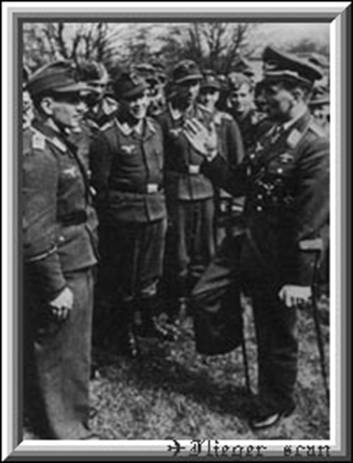
On April 19, a day before Adolf Hitler's 56th birthday, he was called to the bunker headquarters in Berlin for a report before he left with his group to the airfield Maerisch-Schoenau in Bohemia. The Russians had crossed the Oder River and amassed their forces east of the Seelow heights for the final assault on Berlin. According to his own account, Rudel suggests to the Fuehrer that victory in the East is possible if "we can succeed in getting an armistice" with the West. He writes:
A rather tired smile flits across his face as he replies: "It is easy for you to talk. Ever since 1943 I have tried incessantly to conclude a peace, but the Allies won't; from the outset they have demanded unconditional surrender."6
The entire staff lined up to say goodbye and wish him well when he left the bunker long after midnight.
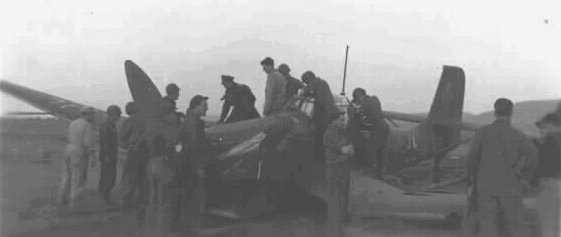
Rudel's Battle Squadron 2 continued to support Field Marshal Ferdinand Schoener's ground forces in the east until the final day of the war, when they decided to try to seek safety in the West occupation zones. On the capitulation day, May 8, he and a few comrades purposely landed their Stukas and FW 190's at their home field in Kitzingen in such a way as to shear off the landing gear and even break a wing. He expected to get medical attention for his leg from the American occupation forces, but instead was "relieved", as were all the crews, of his watch, fountain pen and military decorations, and held for interrogation, eventually sent to camps in England, then France, without medical attention. With difficulty, he finally obtained a transfer to a German military hospital in Bavaria where German doctors provided excellent care for his amputation wound. By mid-April 1946 he was released and had a top-grade prostheses built in Kufstein, Tirol.
AFTER THE WAR
With no prospects in Germany for ex-National Socialists, in 1948 he and friends Bauer and Niermann managed, with the help of "Odessa,"7 to travel to Cordoba in Argentina and became consultants to the Argentine aviation industry.
The regime of General Juan Peron welcomed not only Rudel, but also Prof. Kurt Tank, the Focke-Wulf aircraft designer, and several German test pilots and Luftwaffen officers. At an aircraft plant in Cordoba, they worked on the first Argentine jet plane "Pulqui 2." Rudel continued to keep his body very fit. He climbed the 7020 meter Aconcagua in the Argentine Andes; following that he scaled the 6920-meter Llullay-Yacu peak three times, being the first man to do so even once. He raced, wearing his prosthesis, on the ski slopes of Bariloche, and completed his book, Trotzdem [Nevertheless or In Spite of Everything], which was translated into many languages and sold more than a million copies. His sports trophies continued to mount into the hundreds.
Early in 1950, after the fall of the Peron government, Rudel returned to Germany and immediately became involved in politics, becoming a leader in the German Reich Party. Hitler would have been pleased. Rudel's concern was for the future of the former German soldiers. He justified his participation with the Third Reich by saying it was not for Germany but for Europe that he fought. He criticized the political climate in the Federal Republic, saying "I think that our democracy has not yet reached the level of the USA. There, you can openly say what you think. You can not do it here, unless you express the opinion of the ruling political parties. When I express my opinion, I am right away disparaged and called a Nazi-Colonel. All I dared to say after the war was frank words to those people who insulted me and offended the soldiers. Since then, they called me a 'Radical Right.'" 8
In 1976, the "Rudel Scandal" brought about the early retirement of two Bundeswehr [former Luftwaffe] generals and the Social Democrat Defense Minister Georg Leber. [read about it at http://wapedia.mobi/en/Rudel_Scandal]
Rudel suffered a stroke in 1970, but his fighting spirit enabled him to recover sufficiently to be able to swim, hike and even ski again. But 12 years later, on Dec. 18, 1982, at the age of 66, Hans Ulrich-Rudel, the "Eagle of the Eastern Front"-- the man of whom the last chief of the Wehrmacht in 1945, Feldmarschall Ferdinand Schoerner, said "Rudel alone is worth an entire division!"-- and the man Adolf Hitler wanted to succeed him as Fuehrer of the German Reich, died of heart failure in Rosenheim, Upper Bavaria. He left behind three sons and an unprecedented record of achievement that will probably never be matched, let alone surpassed.
Missions flown against the enemy: 2530 (a world record)
Ground targets destroyed: 2000 (including 519 tanks; 70 assault craft/landing boats, including a Soviet battleship, two cruisers and a destroyer; 150 self-propelled guns; 4 armored trains; and 800 other vehicles)
Air victories: 9 (2 Il-2's and 7 fighters)
Rescue missions behind enemy lines: 6
Shot down/crash landings: 32 (He was never shot down by another aircraft, even though Stalin had placed a 100,000 ruble bounty on his head.)
Wounded: 5 times
Decorations for bravery: 12 plus two foreign. Most decorated serviceman of all branches of the German Armed Forces (apart from Hermann Göring, who was awarded the Grand Cross of the Iron Cross).
During his funeral service at Dornhausen, two Bundeswehr Phantom jet planes circled low over the gravesite 9 where most of his Alte Kameraden, his WWII comrades, were in attendance to bid him farewell with the familiar Nazi salute.
Endnotes:
1. Guenther Fraschka, Mit Schwertern und Brillanten, 1989, Universitas Verlag, Muenchen, p 119.
2. Guenther Just, Stuka-Pilot Hans Ulrich Rudel, 1990, Schiffer Publishing, 277 pg., p 10.
3. Ibid, p 11.
4. Ibid, p 14
5. Ibid, p 32
6. Hans Ulrich Rudel, Stuka Pilot, Ballantine books, New York, 1958, p 267
7. An organization that was purported to facilitate secret escape routes for SS members out of Germany and Austria to South America and the Middle East.
8. Mit Schwertern und Brillanten, ibid, p 125
9. Der Spiegel, "Letzer Flug" [Last Flight], Jan. 1, 1983. "Two days before the holy evening (24 December) last year [...] around noontime a funeral began at the village cemetery. Two Phantom jet planes circled in a strange looking pattern in the sky, crossing and bending in a way that with a little imagination one could recognize as a swastika, as one observer thought. A little later one Phantom dived in the direction of the village church, wiggled with its wings and skyrocketed 300 feet above the village. [...] the Deutschlandlied was intoned in all three verses [...] It did not take the Federal Ministry of Defense long to end the investigations about the ominous Phantom's low level flight, with the result it found the Bundesluftwaffe did "neither on the ground nor in the air participate" at Rudel's funeral.
- Printer-friendly version
- 67770 views
Comments (9)
Rudel
Martin Pegg
Hello,
I was interested to read your article on Rudel which I found essentially very accurate. However, if you would like to include some additional data, I have a few documents you might like to see. One contains a letter written by the SS doctor who amputated Rudel's leg and the others refer to Rudel's post-war political activities, including an unsuccessful plan to free war criminals from a prison in Germany.
If you think you could use these documents, I would be pleased to let you see them.
Best regards,
Martin Pegg
Why did Hitler then leave
Richard
Why did Hitler then leave Karl Donitz has head of government if you think Rudel would have been the next person?
A good question
carolyn
Sorry Richard, for not replying to this earlier. Hitler wanted Rudel to work with him, under him, to learn all that he needed to know, and also so that Hitler could observe his performance in this very different realm. It wasn't like Hitler thought he could just turn everything over to Rudel, as he had to do when he wrote his Last Will and Testament.
Karl Doenitz was experienced and mature, and always exhibited sound judgement. Hitler knew the German people would accept him.
"extraordinary soldierly achievement "
carolyn
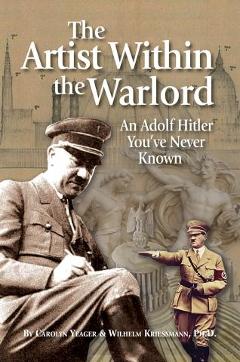
You can read about it directly from Hermann Giesler in The Artist Within the Warlord, pages 199-200. It's why Hitler tried to get Rudel to quit flying and transfer to the Chancellery but he didn't want to force him with an order, knowing how loyal and attached Rudel was to his squadron, and to flying and fighting. Quoting Hitler (p 199):
"For quite some time I've been aware that only a soldier of great status will be entitled to head the nation once I retire after the end of the war. That's why I tried to get acquainted with anyone whose soldierly achievement and manly deeds were extraordinary. [...] "
Doenitz fits the bill too.
Oberst Rudel- the one and only
Herbert Paul
Persönlich lernte ich Oberst Rudel in den frühen 60 ern bei einem Skirennen um die
Westdeutsche Meisterschaft im Abfahrtslauf in Willingen kennen. Er war noch immer
der gleiche Haudegen wie zu seiner aktiven Zeit in der Deutschen Luftwaffe im Krieg.
Er fuhr vielen Jungen Teilnehmern um die Ohren,dass denen Höhren und Sehen
verging.
Als alter Soldat,-15 Jahre Bundeswehr und 20 jahre in der Britischen Armee,kann ich
nur sagen: Wir die aktiven Flieger von heute ( Jahrgang `37) verneigen uns vor seiner
Soldatischen Leistung. Tausende von Deutschen der vergangenen Kriegsjahre danken
ihm ihr Leben ,besonders zum Ende des Krieges,als er Russische Jagdbomber und
Panzer abschoss,die Flüchtlingstrecks auf der zugefrorenen Ostsee zu versenken
suchten. Und dieses mit einer provisorischen Prothese.Ein ganzer Mann.
Nur in Deutschland wurde er von erbärmlichem linken Gesindel in den Dreck gezogen.
In der Englischen Armee habe ich andere Erfahrungen gemacht,dort zählen Soldatische
Tugenden,und sie mischen nicht Männer die ihre Pflicht erfüllen mit politischen
Opportunisten ,die nur ihr Fähnchen in den Wind hängen. Wir Soldaten werden ihn nie
vergessen -
English translation
carolyn
Herbert, I want to thank you so much for this. I'm glad my attention was brought back to these comments by the most recent writer. I asked Carlos Porter to do a translation of this for my readers and me, and he did, right away. Here it is:
Great story
roberto88
Amazing story, an inspiration. Sorry that he didn't have much success after the war in politics, but I did read a line saying that he was a successful businessman.
Thank you!
Hugh Martin
Wow, this is a truly amazing story! Why do we never hear about the incredible German heroes who fought with such determination and bravery for their homeland? Because there are sociopaths in this world who want to keep us deaf, dumb, and blind, mired in belief systems that benefit them at our expense. Many thanks for bringing this story forward!
Double thank you
William77
I have to agree with Hugh Martin. The German people need to hear about the heroism of forebears. For that matter, we Americans need to hear about the valor of men fighting for Germany. Otherwise we are stuck with the nonsensical caricatures presented by Hogan's Heroes, as well as those presented by innumerable Hollywood movies over decades. And we Americans would do well to be given alternatives to phonies like Rambo Stallone, John Wayne, Brad Pitt (inglourias Bastards). And since Whites in general are facing distortion, suppression, and erasure of European/American history and men of valor (Thomas Jefferson, Robert E. Lee), the more we can hear of men worth emulating, the better. Thanks for all your hard work, Carolyn.