



St. Anna – Banat – Hungary/Romania
The History of the Donauschwaben
Compiled and translated by Wilhelm Kriessmann, April 2008
I have had this report in my alt files all this time. I knew I had it and had sent it to some family members, but I had forgotten how complete and how interesting it is. It was my dear friend Willi Kriessmann who encouraged me to study up on my Donauschwaben ancestors and provided me with his assistance, including the connection to Alf Kührt. Willi was an admirer of Maria Theresia and of this eastern settlement project. So with thanks and appreciation to him, I present it now as part of my Ancestry section that I'm building. ~Carolyn
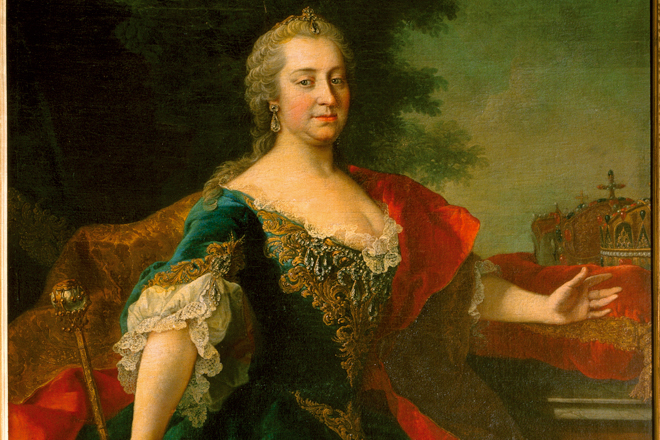
After the Osmans (Turks – Ottoman Empire) were pushed back during the 17th and 18th Century, the Habsburg emperors Leopold I, Karl VI, Josef II and Empress Maria Theresia began to populate the devastated areas of South Hungary. In the lowlands of the Danube and the Theiss (Tisza), farmers and craftsmen primarily from Southwest regions of the Empire were systematically settled. The total number of settlers, organized by the government or private enterprise, reached about 150,000. The majority were from Alsace-Lorrain, Palatinate, Baden-Wuertemberg, Luxemburg and Bavaria (including Franconia).
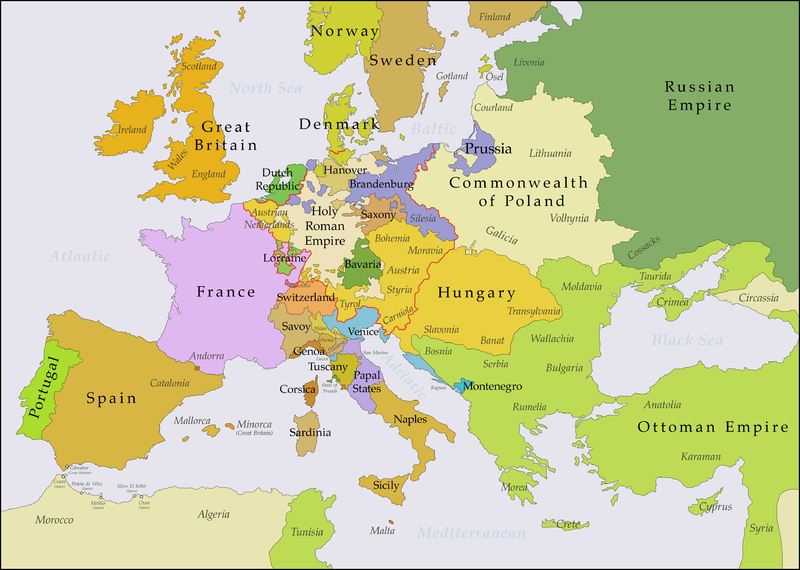
Hessians, Aargauer (Swiss), Westfalians, Prussians, Saxonians, Thueringers, Austrians, Bohemians- Moravians, French and Dutch also found a new homeland here. The documents and the neighbors called them Schwaben even though only a few were really Swabian (from the Kingdom of Swabia – southwest Germany today). The French and Spaniards, for instance, call all the Germans Alemagnes. Only after the First World War, in 1922, when the Danube-Swabian settlements were divided between Hungary, Yugoslavia and Rumania, was the name Donauschwaben coined. [No wonder I never heard such a word in my family – they had all left for the USA by then, between 1905-1908. -cy]
When WWII began, more than one and a half million (1.5 million) Donauschwaben made up the largest German population in Southeast Europe. Escape, eviction and expropriation during and after the war caused a worldwide diaspora, bringing the “youngest, newest German tribe” to an end. In the original regions – today’s Hungary, Croatia, Bosnia-Herzegovina, Serbia and Romania – only a few Donauschwaben still live there. Those few, like the Donauschwaben in the ‘host countries’ of Germany, Austria, USA, Canada, France, Brazil and others where they emigrated, have totally assimilated.
Foundation of the Village of St. Anna
Baron Jacob de Bibich, landowner of all the properties in the Zarabder Komitat (Komitat is district or county) founded the township of St. Anna, in accordance with Empress Maria Theresia’s settlement program of the Banat, passed by the Hungarian Parliament at Bratislava in 1723.
There are two opinions about the actual date.
Andreas Oster, after checking documents and archives in Austria-Hungary for many years and at the church communities in the region, arrives at the following conclusion:
- 1742 Foundation of the community Sanktanna
- 1751 June 8th, arrival of the first larger German families – nine families are from the Kraichgau. (See map at previous post) – today’s northwest Baden-Würtemberg)
- December 4th, another group of twelve families, also from Kraichgau.
- 1752 April 8th, a third group of thirty-nine (39) families arrives, a third of them (13) from the Kraichgau.
- 1753 The last group of 6 families.
Jacob Huebner, author of the monograph of the township Sanktanna, using the historian Sandor Marki and Christian Zenter, and the almanac of two local schools – 1896-97 and 1937-38 – as sources:
- 1736 First arrival of settlers, six (6) families
- 1742 Second group, twenty-nine (29) families
- 1744 Third group, seventeen (17) families
The date of Sanktanna’s settlement is therefore not certain.
About St. Anna
Since its founding in 1742, the name of the village changed with great flexibility. Already six years after the village parish was established, Empress Maria Theresia, Erbkoenigen (hereditary Queen) of Hungary, ordered the change from Komlos (Komlosch) to Sankt Anna. That name included the old Komlos, as well as the surrounding wasteland of FAKO, where the first German families settled.
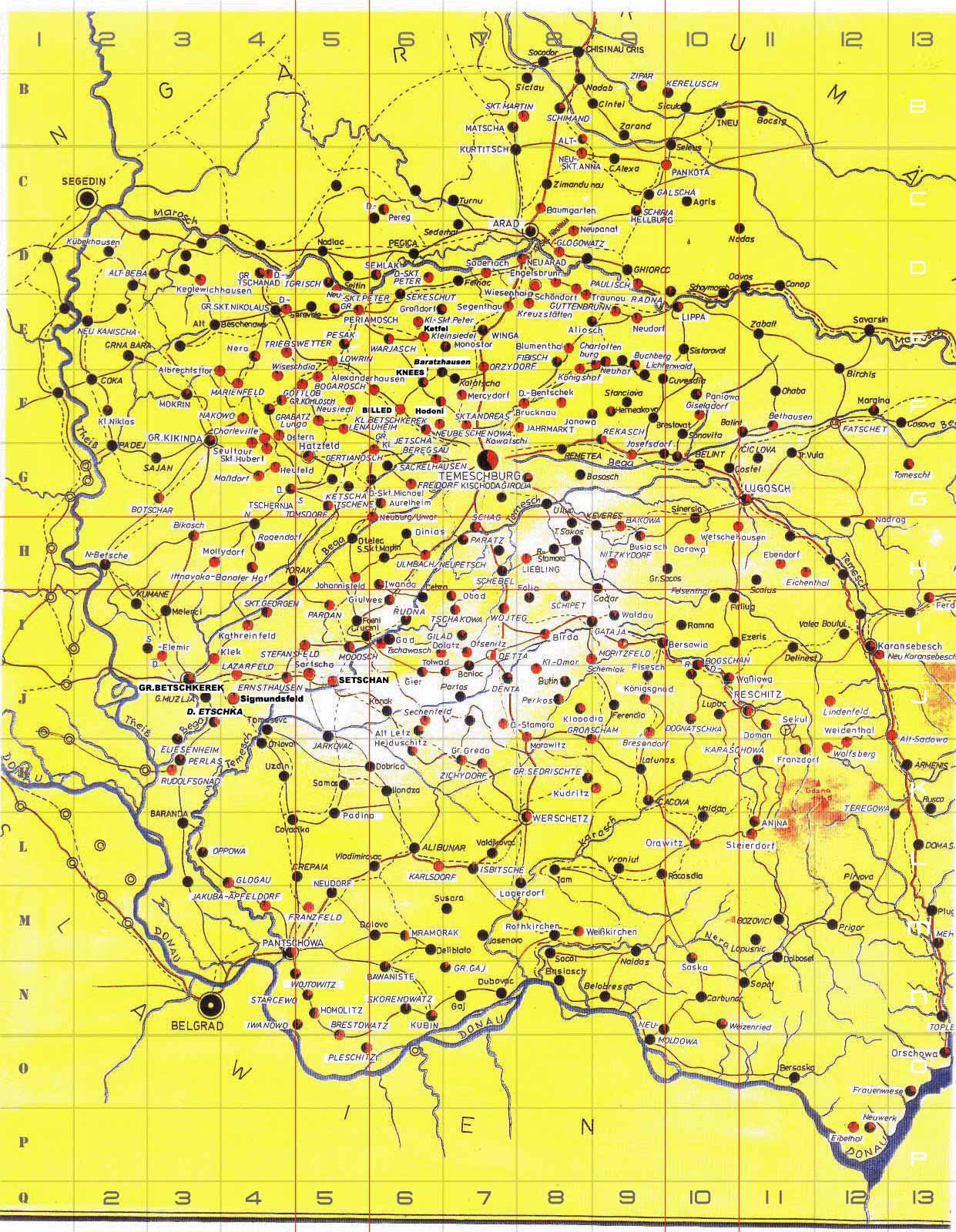
Both settlements, the old and the new, were now marked as ALT (old) St. Anna and NEU (new) St. Anna (see Map above). On the oldest settlement plan or map (1783-84), one can recognize the Hungarian name “Uj-St.Anna” (new St. Anna) on the edge. Up to this date, the twin name was officially used; the local people, however, still used the old name Komlosch.
SzentAnna: The official Hungary ignored the local naming; all maps and documents carry the Hungarian variant, namely “Uj-Szt.Anna/O-Szt.Anna or SzentAnna(Uj) and SzentAnna(O).
Until the end of the 19th Century, the tri-part spelling is kept: Uj-Szt.-Anna or Uj szent anna.
St.Ana: The Romanian classic Ioan Slavici mentioned St.Ana as a neighbor village of “Cumlaus” (Komlos) where he worked as a notary (1869).
Khumlush: The local Germans always pronounced “Komlos” that way, indicating Hungarian roots of Hungarians living there after the Turks left.
Santana: The Swabian “Santana” is a by-ear pronunciation of the Hungarian “Szentanna.”
Szentanna: Changing the three-part name to the one-word name of “Uszentanna” and “Oszentanna” caused great confusion.
Comlaus/Santana: To Romania the ‘new village of Santana’ did not exist. After 1919, the Romanians called the village “Comlaus”, following the Hungarian “Komlos”. Immediately after the regime change of 1919, and until 1935, the railway station and the school report cards carried the name “Santa Ana.”
Sintana: After the Communists took over, a spelling reform took place (1953-54) in order to establish a new national identity, avoiding roots of Christianity and other national identity. Many villages in the Banat and Siebenbuergen were changed.
Santana: The search for a true Romanian identity of the town continued after Ceausescu’s overthrow in 1989. The town council checked historical documents and archives and decided to name the new city Santana.
Social and Cultural Development
Santanna has been associated in Romania as a thriving agricultural community, even though the larger part of the population was not farmers. It’s interesting that the Banater Schwaben south of the Marosch River, especially the ones around Temesvar (Stuhlweissenburg), knew the St. Annares only as successful and tradition-conscious farmers. In order to understand the character of the Santannaer, one has to have a closer look at the history of the settlers, their customs and traditions.
The township of Santanna, far off the main regional as well national traffic connections, has been settled primarily by people from the Kraichgau and Speyer (a city on the middle Rhine, with Kraichgau a little further southeast - see Map from previous post). Mostly farmers from twenty-five different villages, they had their own customs, traditions and religion. They were looking for agricultural land and found plenty of it. Throughout centuries, they could improve wealth and prosperity. A healthy farmer’s community can, however, only exist with good craftsmen around. Therefore, over centuries two social groups developed: farmers and craftsmen. Both were Christians, members of the Catholic Church, but had their own political and cultural life.
Up to the beginning of WWII, only those two German groups were living in Sanktanna. Romanians lived in Altsanktanna (Komlos), belonged to the Orthodox Church and were not known for living as a strong village community [that's putting it nicely -cy]. Up until the Communist takeover, a deep-rooted tradition, and the respective churches, did not allow any interactivity between Catholics and Orthodox.
Dialect
Taking into consideration the original roots of the settlers – coming primarily from the Kraichgau – one would assume that “Wuertembergische” and “Pfaelzerische” would be the language basis. We thought to find some similarities visiting some villages around Speyer.
Jacob Huebner, in his “Monograph of the township Sanktanna,” expresses a different viewpoint. He thinks Sanktanna’s dialect shows distinctive marks of the Suedfraenkisch (South Franconia, around Ansbach), Alemannisch (Baden/Freiburg state), Bayrisch (Bavaria) and Schwaebisch (Swabia). Luckily we know today that the Sanktanna dialect had its roots in the Kraichgau. Mrs. Barbara Novak documented it by her scientific research; there were only slight changes during the 250 years.
After WWII, the Romanian government tried hard to move native Romanians into the Banat and Siebenbuergen to establish an ethnic majority. As a consequence of that policy, Romanians were resettled at the eastern part of Sanktanna (Satul-Nou). Even though the majority of the town was now Romanian Orthodox, there was surprisingly hardly any cooperation between those Romanians and the ones living there for centuries.
We noticed, however, that due to the strong industrialization of the Romanian society and the world-wide inter-relationship of culture, sport and politics, the different ethnic groups in Romania reached closer ties to each other.
World War I
Once again, Sanktanna was drawn into foreign affairs. The war declarations between Austria-Hungary and Germany, the Allies and Romania, involved the peace-loving Sanktannans again. The high school students marched around the town square singing “To the dogs with the Serbs” … but also many farmers complained, “It is unjust what the Kaiser in Vienna is doing to us. He takes our grain at cheap prices and gives us rags…”
The bells of the church tower were ringing the beginning of the war on July 28th, 1914. Many villagers prayed at the village square for Austria-Hungary and then fought for her. The first war victims were young widows and their children. Horses and carriages were confiscated and the church bells were gone also. After the war, Romanian troops occupy the town; Sanktanna is now part of Romania. One hundred young men died in the war and the survivors will be called into Romanian military service.
World War II
For quite a few years we had peace. Sanktanna ordered and adjusted itself to the new political situation. Our young men served in the Romanian Army. All higher officials like Police, Treasury, Railway and Notary Public were now Romanians. But like in the rest of Europe, a chauvinistic air permeated Sanktanna also. First, the Romanian youth organization “Strajerli” (Guard) was founded. All German schoolchildren join “Strajerli,” wearing white blouses, marching, singing, hoisting flags every day.
The singing of songs continues when the NSDAP arrives in Sanktanna and with it Die Fahne Hoch (The Flag High – otherwise known as the Horst Wessels song). All school classes accompanied by brown uniforms march to the cemetery, commemorating the fallen heroes of WWI. All are organized into the Deutsche Volksgruppe (German Folk Group). The pact between Hitler and Marshal Antonescu (Ion Sima – Iron Guard, like German SA) ends with the war against Russia. At the beginning of 1941, our young Sanktannars are called up for service in the Romanian army. On June 6th, Romanian troops cross the River Pruth and march into Russia. Bessarabia and Bukovina return to Romania. After initial success, the German-Romanian armies pull back. In 1943, all young ethnic Germans are transferred from the Romanian Army to the German Wehrmacht.
Many Sanktanners, like Anton Hoeniges, preferred to serve in the German army. Food, treatment and cultural background were probably the deciding factors. At a big rally at the market square in Sanktanna, May 1943, the village judge Franz Mayer said in front of an aroused crowd: “The participation of all men from the Banat liable for military service is a voluntary must.”
Eight hundred (800) Sanktannars march into a war which is already lost. Crying wives, mothers and children remain. When the Romanian Army changed sides on August 23, 1944, great confusion seized the villagers. From then on, no messages about their soldiers would reach the village. Deep sadness took over. Immediately after the Russians march in, the punishment of the Banater Schwaben starts – they are accused as warmongers.
Young Sanktannars in Russian Camps
One thousand young women from Sanktanna are deported to Russia – forced into restitution work. No compensation, no apology is ever offered by the Romanian government.
World War II toll in Sanktanna
350 dead or missing 270 women died in Russia
Expropriation from all Germans No pension for war widows
Service in the Romanian Peoples Army
The consequences of the lost war are lasting. Sanktanna completely lost the confidence of the new Romanian government. But her young men must still serve in the Romanian Army. Children of the war generation are accepted in the Romanian youth organization; they sing again, however under the star of the Romanian Communist party. The star is omnipresent. Direct or indirect, all Sanktannars have to participate in the restructure of the socialistic society. Defense of the country is the task of the Romanian Army. As a member of the Warszawa Agreement, the militaristic and propaganda strategy is primarily directed against NATO allies, but specifically towards the Federal Republic of Germany. With that in mind, all Banater Schwaben face an historical identity problem. Without loss of their roots and identity they cannot remain in a state of forced nationality. The only way: resettlement in Germany.
Emigration to Germany
Aussiedlung (Emigration) is the official German description of the resettlement of members of German ethnic groups from Eastern Europe, according to the Bundes-Vertriebenen Gesetz 1953. The resettlement of the German population of Sanktanna took place within the space of 25 years and reached 95%!*
From 1975 to 2000, six thousand (6000) Sanktannars left and found their new Heimat (home) in Germany.
*According to the 2011 census, the Santana population is 10,725, breaking down ethnically as 85% Romanian, 9.5% Roma, 3% German, 2% Hungarian. 79.6% are Romanian Orthodox, 11.5% Pentecostal, 5.5% Roman Catholic and 1.2% Baptist.
Historical Doubts about the Banat Experiment
After Austria’s defeat by Prussia and the following peace treaty of Königgraetz, Chancellor Bismark initiated the disintegration of the Habsburg Monarchy: “A strong Magyardom is strategically of great importance for the protection of the southeast flank of the German Empire.” The double monarchy Austria-Hungary was founded in 1867 under that assumption. Austria had to cede the Banat to Hungary. All the privileges granted by Maria Theresia to the settlers in the Banat were recalled by the Hungarian government. Language, tradition, identity and culture were attacked. The first doubts about the settlement in the Banat arise. Magyarization follows.
Dissolving the Territorial Unity of the Banat
After Germany’s and Austria’s defeat in WWI, France and England decided to divide the Banat. The eastern part went to Romania, the western part to Yugoslavia. The loss of territorial integrity destroyed the identity of the German settlers for good.
The Thought about Escape
After the retreat of the German army from Romania, thought about fleeing already began. But then the villagers doubted if they could succeed. The battle lines (front) changed from day to day.
King Michael and his Dubious Role
Already during the war, in 1943, King Michael started secret negotiations with the Allies for an early withdrawal of Romania. Finally Romania changed alliance. By October 25, 1944 Romania was occupied by Russian forces. King Michael tried to save his kingdom in vain. During his regency, the persecution of the Germans in the Banat and Siebenbuergen (Transylvania) began. They could not hope for any help from the House of Hohenzollern.
Consequences of the War
Escape thoughts turn into emigration matters
Immediately after Romania’s occupation and with the knowledge of King Michael, the Communists began prosecuting the putative war criminals. German women and men were sent to forced labor in Russia in order to pay for the war debt. Two hundred eighty (280) citizens of Sanktanna had to pay for it with their lives. At the same time, the Romanian government decided on the expropriation of all German property. For many villagers that meant loss of property, injustice, persecution and deportation. Emigration became the major concern of the villagers; most of them thought they should have left Sanktanna during the war. All Romanian governments, however, denied the emigration plans of the Germans.
Nicolae Ceausescu was the head of Romania from 1967 to 1989. By his nationalistic foreign policy, he obtained a certain independence from the Soviet Union. With the help of his secret service “Securitate”, he could successfully pursue his major goal – to remain in power. His social policy aimed at a multilaterally developed society. All officials and party members were supposed to follow that policy. It should guarantee all ‘minorities’ individual identity and tradition. The minorities considered those cultural programs ordered by the government as trials to assimilate. Ceaucescu’s economic policy aimed for a forced industrialization. To realize those goals, he used forced resettlements and an increase of debt to foreign lenders. The deficit of the Romanian state shot sky high. In order to balance that deficit, Ceaucescu ordered an increase in the export of consumer goods which sharply reduced the supply for the domestic market. The Romanian people suffered, while Ceaucescu, his family and political friends lived in luxury.
Family-Reunion or Emigration
Based on international agreements specifically with the Federal Republic of Germany, Romania practiced a “benevolent” policy regarding the reunion of families. As a service in return, Germany agreed to compensate Romania for its effort. The agreement provided only a limited number of family reunions per year. The people who wanted to emigrate and wanted to be included in the annual quota had to come up with their own additional funds. The emigration statistic shows that emigration was preferred to family reunion.
Germany, the Goal of Emigration
The government of the Federal Republic of Germany declared its full responsibility for all German “after war affairs.” For the resettlement of ethnic Germans, the Federal Republic was the only place to be considered. The original homeland of the Volksangehoerigen (ethnic Germans) is located in the Federal Republic: Baden-Würtemburg, Rheinland-Pfalz and Bayern. Deeply rooted in tradition, language and culture, the Banater Schwaben considered Germany for centuries as their Stammland (original homeland). Political freedom, prosperity, cultural and economic achievements are greatly appreciated by the Banater Schwaben.
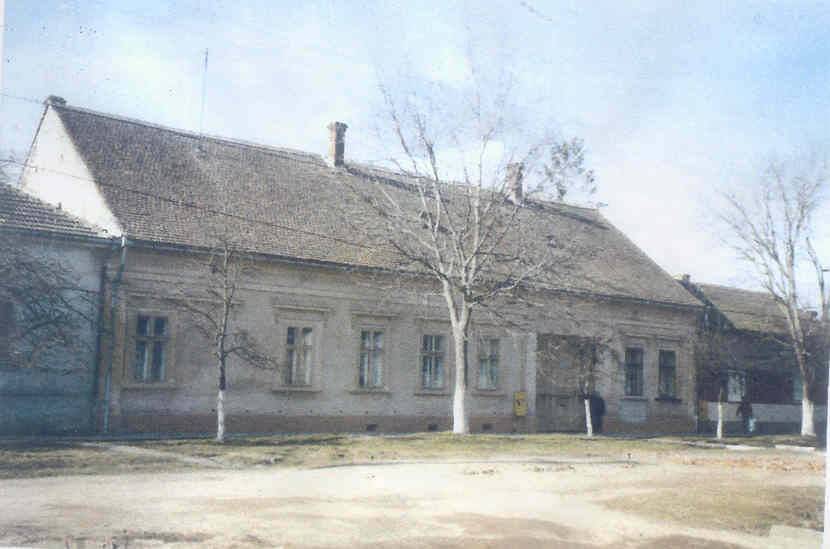
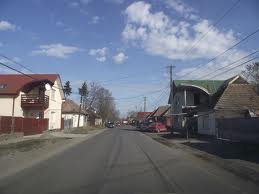
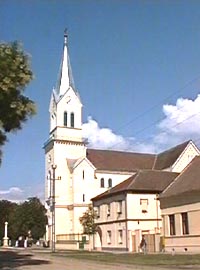
Santana today, void of Germans, is just a dumpy Romanian town. I found this picture (above) of a 100 year old house for sale. It's described as having been built by a wealthy German, well-constructed with many amenities including gardens and orchard. 4 bedrooms, 1 bath. Price: 62,500 Euros. Below are two other pictures of present day Santana: Left, a street with houses, Right, a German church with other buildings.
- Printer-friendly version
- 11191 views
Comments (12)
Thank you so much!!!!
Penny
Thank you so much!!!!
Any information on the parents of Barbara Schwarz?
Are you the one selling the town family records book? If so, what is the cost of a copy and could I get one please?
Barbara Schwarz
carolyn
You're very welcome, Penny. Sorry I didn't get back to this until now. Hope you see it.
Barbara Schwarz was born to Josef Schwarz and Barbara Jaeger in 1898. There is no death date. Her siblings included Mathias, born 1896; Anna, born 1893; Johann, 1890; Josefa, 1888; then Rosalia, born 1900; Stefan, born 1902 who went to Canada, married Anna Bissinger in 1926.
Barbara's father Josef Schwarz, a farmer, was born in 1861 to Mathias Schwarz and Anna Weckerle. Mathias was born in 1835 to Johann Schwarz and Katharina Strohhaecker.
Johann was born 1813 to Andreas Schwarz and Otilia Schmidt. First wife K.S. died in 1836, age 20; in November 1836 he married Katherina Weckerle.
Andreas born 1781 to Johann Veit Schwarz and Magdelena Bauer. In 1825 he married Katharina Fink and in 1845 Marianne Henger.
Johann Veit was born in Germany around 1739, but it doesn't say where.
No, I'm not selling the family book. Josef Lutz in Germany sells it; email him [email protected] <[email protected]>. Read about it here: http://www.dvhh.org/banat_villages/Arad/Sanktanna/index.htm It says this page was last updated in 2019.
It's two matching heavy books and has to be paid in euros. I did that through my bank. But talk to him; he's very nice.
kemerle
edna
Marie Kemerle 1890 St. Ann/1971 Bloomngton, Il, USA. Father Andrea and mother Rosia Sundner, brother Frank. Would like to know were they came from to St. Ann as well as any thing about the family. Married Joe Hauptman from Pankota in USA.
From the Santana Family Book
carolyn
Maria Kaemmerle, born 18 January 1890 to Andreas and Rosalia Sandner Kaemmerle; died 3 July 1971 in Bloomington IL.
Andreas Kaemmerle born 30 Nov 1847, no death date. Listed as a soldier. His parents were Johann and Aloisia Zimmermann Kaemmerle. Johann, born 1819, died 1883
Before that, Jacob, 1777-1840
The earliest Kaemmerle in Santana is listed as Johann, born 1750-51, died 1816. Married Maria Magdelena Steger in 1775 in Santana. No further information.
Hauptman
Joe Hauptman, born Pankota 16 May 1886; died Bloomington 28 April 1962. Married Marie Kaemmerle on 28 January 1911 in Bloomington, IL. Marie was born in Santana in 1890, died Bloomington, 1971
Joseph's parents: Johann born 1851, died 1929 Bloomington, and Rosalia Bettisch born 1859 Pankota, died 1924 Bloomington
Johann's parents: Johann born 1825, died 1897 Pankota and Theresa Silbereis.
Johann's parents: Peter born around 1782 in Polgardi. Not all families have information on their origin in Germany.
Gregor - Eberlein - Gantner
Connie
I was very close to my grand parents - all from St. Ana Hungary/Romania.
Great Grandma Paulina Gantner (b.1883) eloped with Josephus Eberlein (b. 1872) Nov 1900,. He owned a bar in Sintana (bar one side - coffee house on the other...according to Granny).
No sibling information can be confirmed.
Grandpa Joe (Joseph Gregor b. Jan. 21, 1899) was a pastry chef in Sintana as wsa his father before his (Joannes gregor) - his mother was Eliabetha Schmidt. I have seen marriage registry but nothing else.
Also Granny (Paulina Eberlein) ran a stationary store around 1915 in the town.
I would love to find out more. Am from a small fmily (1 sibling) and my parents each had only 1 sibling.
Hi Connie, sorry for taking
carolyn
Hi Connie, sorry for taking so long to get to this. I found Josef Eberlein (3-16-1872 to 3-11-1937), married Pauline Gantner on 11-3-1900. Josef was the 3rd child of Ferdinand and Anna (Daminger) Eberlein. Siblings: Barbara 1868-90, Katharina 1869-88, Anna 1874-1953, Maria 1876-1962, Ferdinand 1879-85.
Pauline Gantner was born 6-18-1883 to Johann and Maria (Horn) Gantner. She didn't die in Santana so probably in the US, doesn't say though. Pauline was their first surviving child, later a brother Alexander Johann (1890-1933) who was a Civil Servant and married Maria Buttinger in 1912. The parents J&M had 4 children that didn't survive.
Elisabeth Schimdt was born 10-11-1874 to Franz and Theresia (Hoeniges) Schmidt. She is listed as a (Baker), parentheses meaning along with her husband, I assume; married Johann Gregor on 2-19-1895. His dates are shown as 1871/72 to 1927 but there is no Gregor family name in the book, so he was not born in Santana. Elisabeth had only two younger siblings who did not survive.
I hope this helps you put it together. If you have any further questions, just ask me and I'll see if the book has any anwers.
Luxembourg
Robert
Hy, i am lokking for some Infos from or over Luxembourg in 1776. Mabe someone can help me here please?
Thank you
Sorry Robert. No help here.
carolyn
Sorry Robert. No help here. Unless a reader who sees this can help you.
John Sylvester Kohler
Robert Koehler
I would appreciate any info available about my father's family. His name is John Sylvester Kohler and was born Dec. 31, 1900 in St Anna, Hungary.
There's not much information
carolyn
There's not much information about your father. He was born in St Anna when you say, the son of Josef Köhler and Anna Metz. But his father was not born in St. Anna so is not listed by number in the book. His mother Anna is shown to have been born in St. Anna to Johann Metz and Eva Köhler on June 17, 1871. Anna married Josef Kohler on Feb.25, 1889. Johann was a farmer born 1832 to Kaspar Metz and Elisabeth Traner. Kaspar was born in 1788 in Elek(Hungarian town) to Josef Metz and Getrud Lehmeyer. That's as far back as it goes.
Back to your father, John Sylvester, it shows he died on May 7, 1963 in El Monte/Kal., wherever that is. He married Antonia Maria Novasad in Chicago, IL on May 4, 1929 (Maria b1900-d1999). She was not from St. Anna.
Teiber's in Bloomington
George Teiber
My great grandfather (Gregorius Tauber) and his son (Gregor Tauber) came to the US in 1903 from Sanktanna. The name was changed at immigration to Teiber. Tauber was crossed out and Teiber was written above Tauber. Gregor changed his name to George and was known as George Teiber. He married Mary Willi, also from Sanktanna, in 1906 in Chicago. George was one of the founders of West Side Clothing, which catered to the workers at the railroad yards on the west side. West Side Clothing closed after 102 years in business, the oldest business in Bloomington when it closed. Mary Willi's sister, Anna, married Joe Kaup, from Sanktanna, and they lived on the west side. My father, Anthony George teiber was born in Bloomington and is buried there.
Hi George
carolyn
So your grandfather, George Teiber, was a contemporary, friend, and business partner to my grandfather, Steve Yeager. Your original name spelled Tauber was probably pronounced like TIYBER so that's why the immigration official changed the spelling (as a helpful move). The same with Jåger, pronounced in English YAYGER (long A); the spelling was changed to Yeager so it would sound the same. [I'm saying this for the readers' benefit, as I'm sure you know this.]
Yes, I've known that when the store opened it was owned by Yeager and Teiber. Then later it was Yeager-Schillinger. I remember the store very, very well--even worked there a few Sunday mornings in my teens. Did you grow up in Bloomington? Are you still there? I do recall the name George Teiber from the "Club" but I'm not sure if I have the face right. I can still picture Joe Kaup pretty well; Joe Kaup the younger, of my father's generation.
I knew Clark Taminger, who ended up as the sole owner, and the whole Taminger family; was even related to them through my mother's side. Do you know the German spelling was Daminger? "D" sounds more like the English "T" in German, so it was the same story.
My mother died in 2006, and my brother in 2007; that's the last time I was in Bloomington, although my brother's widow is still there. Some long-time Club members live across the street from her.
Thanks for writing! And email me at [email protected] if you want. My best wishes to you and your family. -Carolyn