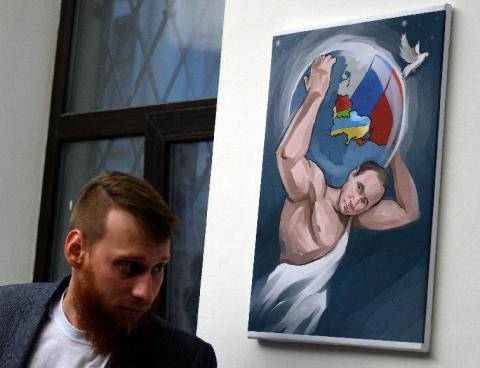
Muscle-man Putin depicted shouldering the entire world, with Crimea featured.
Vladimir Putin's 62nd birthday today comes at a time of great popularity at home for the leader mainly because of his takeover of Crimea.
As part of the festivities, supporters in Moscow staged an exhibition of paintings designed to symbolise Putin's achievements, comparing them to the "12 Labours of Hercules", the demigod of Greek mythology renowned for his strength.
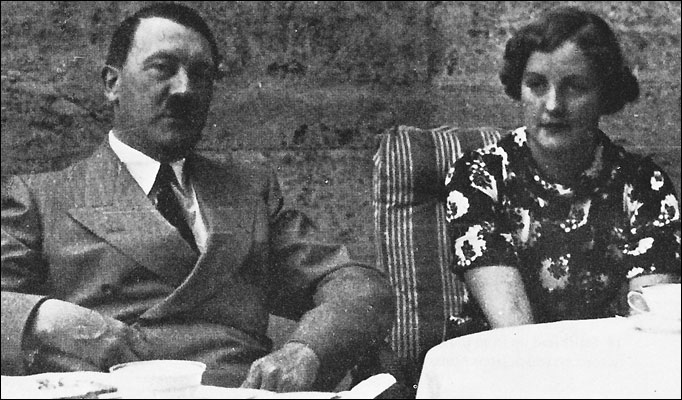
Unity Mitford, of the famous English Mitford sisters, seated at table next to Hitler in Bayreuth, Germany in 1936. Hitler says in this episode he liked best dining with pretty women.
Ray Goodwin and Carolyn Yeager read and comment on the March 7-24, 1942 dinner table monologues by the German Leader, as taken down in shorthand by trusted aides. On March 21st the note-taker switches from Heinrich Heim to Henry Picker. 1hr36min. Included in this episode:
Jealousy among women explained as result of prehistoric period when female protection depended on one man;
Hitler compares men and women to the detriment of women at 3 different mealtimes;
Hitler on smoking and why/when he quit the habit-(Who knew he had ever smoked?!);
Questions of the Wehrmacht, private property vs the State, lotteries and gambling, Capitalism and monopolies;
Stafford Cripps a more threatening figure than Churchill to the health of the British Empire;
The disastrous influence of Jews on the Arts--the genuine artist and the fake.
The edition of Hitler's Table Talk being used was translated by Norman Cameron and R.H. Stevens, published by Enigma Books, New York, and can be found as a pdf here.
have ben made to this website in the three years since it's inception on September 27, 2011, making a total of 186,400 visits in this past year alone.
This represents an increase of 70% over the previous year. or 54,000 more visits than in 2013. This compares to an increase of 57% in the 2nd year over the first. Thus, I have grown at a faster rate each year, which is good news!
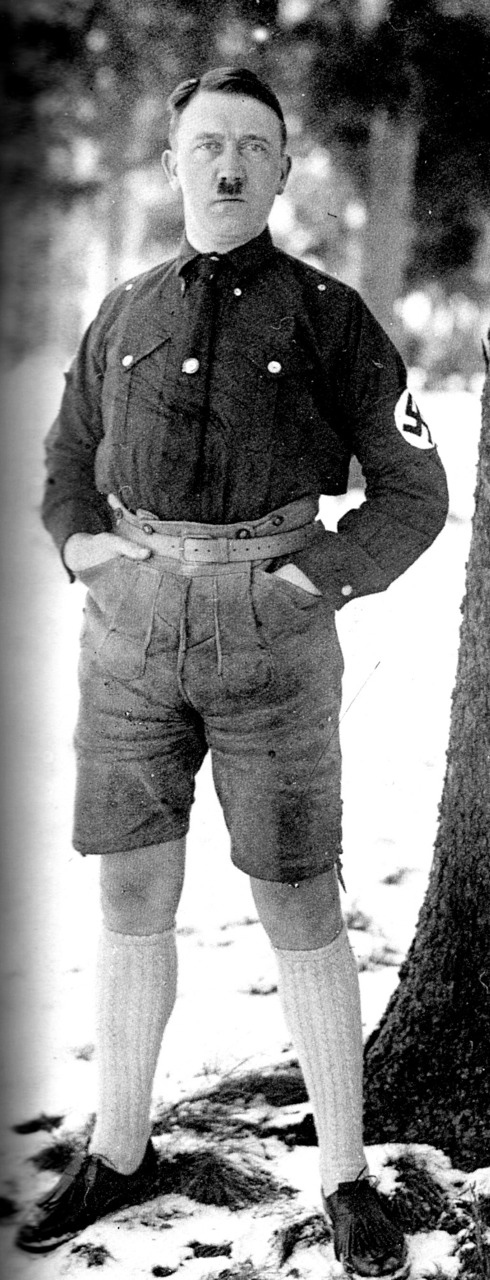
Hitler liked wearing lederhosen during the 1920's, which he said was not considered acceptable attire in North German society.
Carolyn Yeager and Ray Goodwin read and comment on the Feb. 17-22, 1942 dinner table monologues by the German Leader, as taken down in shorthand by trusted aide Heinrich Heim. Included in this episode:
Country estates in Hungary compared to Wagner's Wahnfried and his own Berghof, and the stories of Karl May compared to American classics;
Hitler's preference for Bavarian-Austrian lederhosen (leather shorts for men) and why he had to give them up;
Wrong to shower too much care on colonial subjects, plus not enough theaters in Germany;
Why Hitler plans for his great observatory to be built at Linz, and the importance of teaching the people the wonders of the physical universe;
The privilege of playing the role of patron to the arts and sciences;
Ferdinand Porsche is the greatest engineering genius in Germany at the time, and Hitler sees continued success for the Volkswagen;
Praise for Schwartz and Amman as great talents who served the NSDAP, plus strong words against the "Jewish virus."
The edition of Hitler's Table Talk being used was translated by Norman Cameron and R.H. Stevens, published by Enigma Books, New York, and can be found as a pdf here.
Here is a brief version of my ancestry from the research and compilation by Alf Kuehrt of Nuremberg, Germany for the publication Famlienbuch Sanktanna which he updates every year.
There are 363 family names in the current (2014) 2-volume book, all but 62 of them German. Kuehrt devised a numbering system that allows one to easily find the parents and marriage partner of each person born in Sanktanna, thereby one can discover all the inner-family connections, and maybe a few surprises!
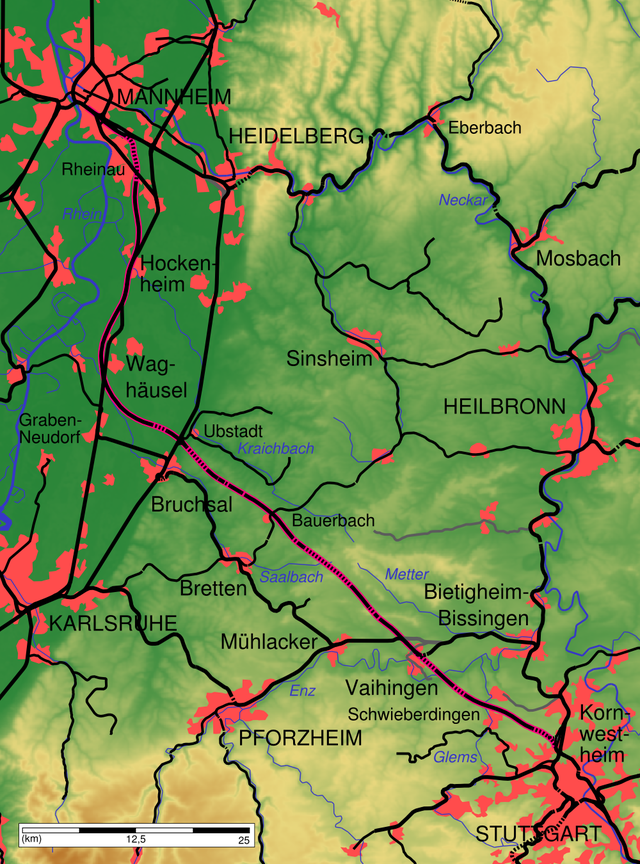
I would like to take my ancestry further back in Germany. A majority of the first families to arrive in Sanktanna (St. Anna) came from the Kraichgau in Baden, a fertile area between Heidelberg and Stuttgart. The Reck family did come from Bauerbach in the heart of the Kraichgau, which is north-northwest of Stuttgart. Enlarge map. Please check out my radio program "In Praise of My Ancestors". I hope to find out more still about my German roots whom, I am pretty confident from the information I have, all traveled to Sanktanna from the Kraichgau or very close nearby areas in Baden. The names of these men and women going back 6 to 7 generations is enough to show that I am German through and through. Following these genealogical lists from my grandparents back, you will find a little bit about the German town of Sanktanna, written by Herr Kuehrt.
Translated and condensed from Hermann Giesler's Ein Anderer Hitler by Wilhelm Kriessmann and Carolyn Yeager
This is a condensation of the 15-page section Der Zwist on pages 340-355
copyright 2014 Carolyn Yeager
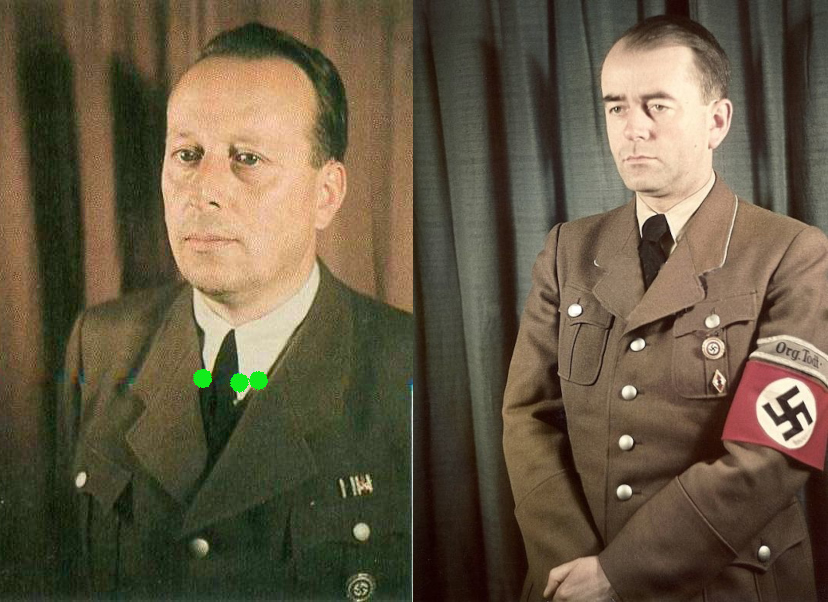
“ Powerful and at the same time not interested in power” … so judges the American historian, Professor Eugene Davidson, about the author Adalbert Speer, when reviewing his book Erinnerungen.
The following footnote (Chapt. 4, #32) from Joachim Fest’s Speer: The Final Verdict reveals the disdain Albert Speer felt toward Hermann Giesler that was probably the root of the problems between the two men.
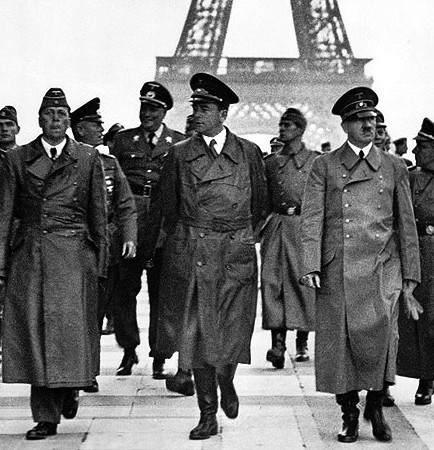
“… in the caption to the picture showing Hitler in front of the Eiffel Tower, (Speer) mentions Breker but not Giesler on his right. […] In conversation Speer remarked that Giesler had been distinguished “beyond merit” by Hitler's invitation. Asked if he had been jealous of his rival, he replied, ‘How should I have been jealous of him? Giesler was a frightful petit-bourgeois! How could he supplant me in Hitler's favor?’ […] How unremitting Speer’s feelings were for Giesler emerges also from the fact that he consistently misspells his name with what seems like pointed indifference.”
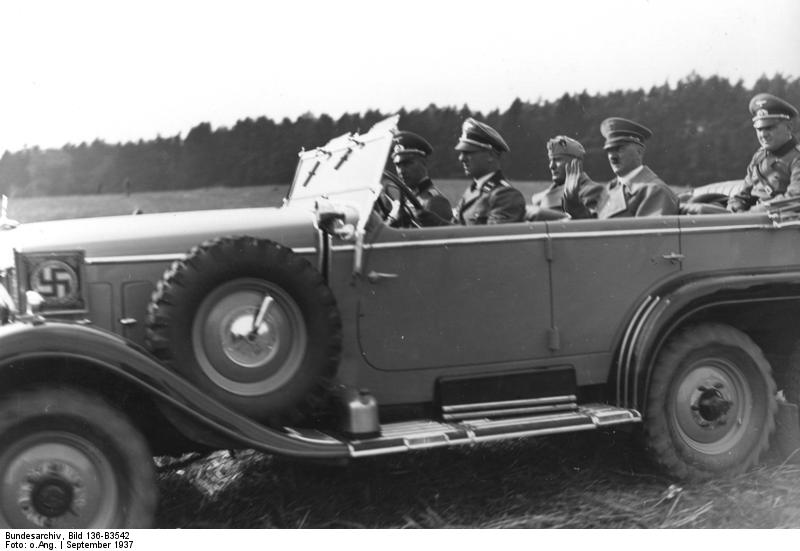
Adolf Hitler with Mussolini and his military adjutant Col. Hossbach in rear, driven by his personal Chaufferur Erich Kempka.
Ray Goodwin and Carolyn Yeager read and comment on the Jan. 23-26, 1942 dinner table monologues by the German Leader, as taken down in shorthand by trusted aide, attorney Heinrich Heim. Included in this episode:
Hitler enumerates the good qualities of the Czechs and the dangerous qualities of the Jews;
England must choose between Europe and it's Eastern colonies;
Taxes and the problem of bureaucratic overgrowth - Jodl and Himmler comment;
Hitler waxes lyrical about Richard Wagner and family, which leads to how strenuous the annual Party Congress in Nuremberg is for him;
Fuehrer chaufferurs, their training, and appreciation for motor-cars;
Realities of marriage and why it's not for him, plus the joy of beautiful women.
The edition of Hitler's Table Talk being used was translated by Norman Cameron and R.H. Stevens, published by Enigma Books, New York, and can be found as a pdf here.
This film from 1937 is a joy to watch as we see German-American boys engage in the same type of camping life and sport activities as their ethnic cousins enjoyed in the German homeland. What an extraordinary opportunity this camp experience provided them for discovering and demonstrating their natural gifts of industriousness, teamwork, discipline, comradeship, health and fitness ... and just plain fun. I like it so much I just had to archive it here. ~CY
In Volks-Deutsche Jungen in U.S.A. (German Youth in the U.S.A) you’ll see what first appears to be an unremarkable story of a boys’ summer camp. The film starts with the camp under construction and excited children piling onto chartered buses to make the journey from New York City to Windham, New York in the summer of 1937. The boys pitch tents, unload crates of baked beans, and perform physical fitness drills. If you pay close attention, you might notice that some of the boys are wearing shorts bearing the single lightning bolt insignia that marked the younger contingent of the Hitler Youth, but it’s not until the “Flaggenappell” (flag roll call) at 13:47 that the affiliation becomes clear.
The camp the boys and young men in this film attended was operated by the Deutsche-Amerikanische Berufsgemeinschaft (DAB), more commonly known as the German-American Vocational League or the German-American Bund. The DAB, which came to include more than 70 local chapters, was founded in 1936 to promote Germany.
These films were the property of an independent organization. The sequence of events that led to the film coming to the Motion Picture Preservation Lab began when the U.S. government searched the DAB’s national headquarters on January 5th 1942 [almost immediately following the state of war between the U.S. and Germany -cy]. Under Federal Grand Jury Subpoena, agents seized scores of 16mm films and sound recordings that documented the activities of the DAB. The audio-visual material comprised what was labeled “EXHIBIT 147” in the case against the DAB’s un-American activities. These films and sound recordings are held at the National Archives as records of that investigation. An archivist discovered them in the textual holdings in the late 1980s and transferred to the Motion Picture, Sound, and Video Branch at that time.
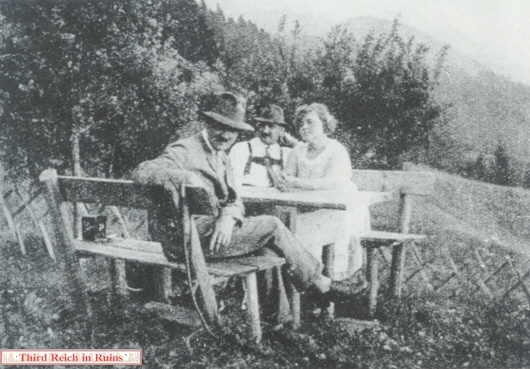
At the Hochlenzer Gasthaus (restaurant) in Berchtesgaden, Adolf Hitler sits at an outdoor table with Bruno Buchner and his wife, proprietors of the Platterhof Hotel, Obersalzburg.
Ray Goodwin and Carolyn Yeager read and comment on the Jan. 13-17, 1942 dinner table monologues by the German Leader, as taken down in shorthand by trusted aide, attorney Heinrich Heim. Included in this episode:
Hitler talks about Czechs in general and Emil Hacha in particular;
Men of genius like Austrian composer Anton Bruckner, who was unappreciated for so long, must be encouraged;
High birthrate at the time in India, in Russia, but also in Germany;
A woman of genius: Angelica Kauffmann was a very great painter, says Hitler;
The early days in Obersalzberg wth Dietrich Eckart - he was known only as Herr Wolf until he began giving public speeches - how he bought his house "Wachenfeld";
Recalls the many friends from those days, which were the best days in his life, and how he enjoyed the ladies and pretty girls;
Praises Dietrich Eckart, calls him the "polar star" to the early National Socialists and his death a great loss.
The edition of Hitler's Table Talk being used was translated by Norman Cameron and R.H. Stevens, published by Enigma Books, New York, and can be found as a pdf here.