


Home
Carolyn Yeager
Now Retired but Still Readable

Main menu

  • Home
  • Welcome
  • About
  • Contact
  • Kriessmann Archive (opens in new tab)
  • Donate

Breadcrumb

  • Home
  • "Hitler's Table Talk" Study Hour

Radio Archives

  • The Heretics' Hour
  • Saturday Afternoon
  • "Hitler's Table Talk" Study Hour
  • "The International Jew" Study Hour
  • Wehrmacht War Crimes Bureau
  • The Revisionist Report
  • Other Podcasts
  • Problems Listening?

Click here to go to Elie Wiesel Cons the World

Elie Wiesel Cons the World

Popular Articles

The Fake Legends of Adolf Hitler’s “Jewish Grandfather”
Views: 180,880
How many times does it have to be said? Hitler didn't have dark hair.
Views: 82,301
"Why We Are Antisemites" - Text of Adolf Hitler's 1920 speech at the Hofbräuhaus
Views: 71,003
Hans-Ulrich Rudel: The man who might have been the next German Führer
Views: 67,317
The Search for WWII Mass Graves
Views: 53,585
The Solutreans - First Americans May Have Been European
Views: 46,922
Auschwitz: The Underground Guided Tour
Views: 44,383
The Gleiwitz “False Flag” Incident is Pure Fiction
Views: 41,922
Known Pedophile is Instrumental in Promoting Holocaust Hoaxer and Plagiarizer Denis Avey's New Book
Views: 40,710
Meltdown for Tanstaafl
Views: 35,243
The Case Against Denis Avey, the BBC, and the British Government
Views: 27,120
Gerhard Ittner may seek justice from UN Human Rights Committee
Views: 26,152

The White Network

Click here to buy my book, Auschwitz: The Underground Guided Tour
Read this book

The Scriptorium

"Hitler's Table Talk" Study Hour

"Hitler's Table Talk" Study Hour: Introduction - Episode 1

By carolyn | 4:53 PM EST, Thu March 06, 2014

Your browser does not support the audio element.

HTT_1_3-6-14.mp3 (11.85 MB)

March 6, 2014
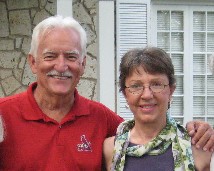
Carolyn and Ray 2010
Image
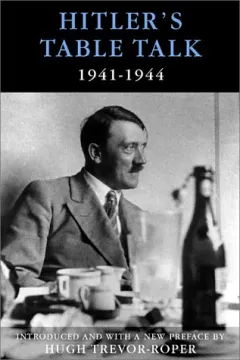
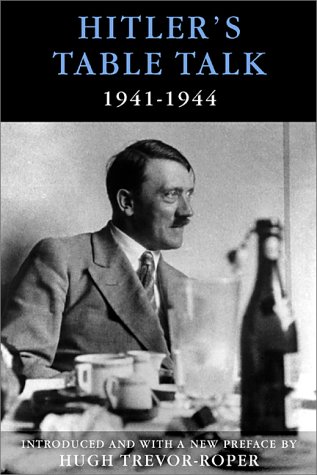
Hitler's Table Talk by Trevor Roper - Cover
Hitler's Table Talk by Hugh Trevor-Roper - Cover

Carolyn Yeager and Ray Goodwin  use their first program to introduce listeners  to some background information on this collection of what are basically after-lunch-or-supper monologues by Adolf Hitler in the company of his intimate circle. 52m


  • How trustworthy is this text, since Martin Bormann assigned two of his aides to take the notes during meals, then turn them over to him for checking and safekeeping;
  • Why it is valuable to study this book;
  • Questions about the translation and translators – for example, did Francois Genoud tamper with the parts about Christianity;
  • Of those offended by this book, Christians are #1 on the list, complaining that it does not agree with Hitler’s “public record” of positive remarks about Christianity in earlier years;
  • David Irving and Albert Speer both confirmed that these recorded talks are authentically Hitler; Richard Carrier disagrees;
     
  • Next week we’ll begin reading the text.

The edition being used was translated by Norman Cameron and R.H. Stevens, published by Enigma Books, New York, and can be found as a pdf here.
  • Read more about "Hitler's Table Talk" Study Hour: Introduction - Episode 1
  • 1 comment
  • 3144 views

"Hitler's Table Talk" Study Hour: Episode 2

By carolyn | 4:09 PM EDT, Thu March 13, 2014

Your browser does not support the audio element.

HTT_2_3-13-14_0.mp3 (13.48 MB)

March 13, 2013

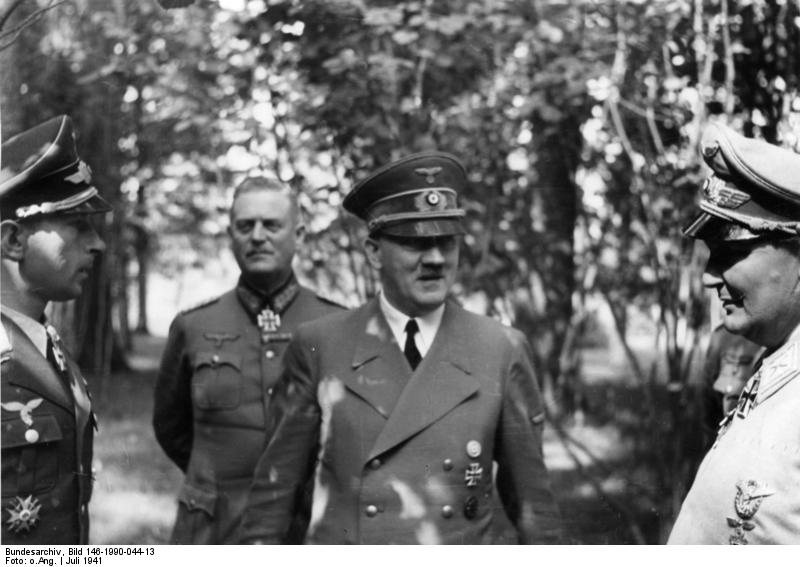
Werner Mölders bei Adolf Hitler

Carolyn Yeager and Ray Goodwin read and comment on the Sat. July 5th through July 15th, 1941 dinner table monologues by the German Fuehrer, as taken down by an adjutant and checked for accuracy by Martin Bormann. 59m. Some highlights from the program:

  • Russians do not naturally incline toward a Western, Aryan type of organized state;
  • Expansion into the East will create new tourist destinations reachable by autobahn;
  • Moscow must disappear and Bolshevisim be exterminated;
  • The dominion of natural law, no education in atheism, Christianity less tolerant than the ancient world;
  • Moral law governs the actions of Germans, making them uniquely capable of a revolution in religion;
  • Racial migrations, and “way of eating” a typically racial characteristic;
  • Stalin an extraordinary figure in history.

Image: July 1941. A proud time: Hitler with Field Marshal Keitel and Reichsmarschall Goering (far right) in conversation with Knight's Cross winner Werner Mölders (left). [click on image to enlarge]

The edition being used was translated by Norman Cameron and R.H. Stevens, published by Enigma Books, New York, and can be found as a pdf here.

  • Read more about "Hitler's Table Talk" Study Hour: Episode 2
  • 2 comments
  • 1495 views

"Hitler's Table Talk" Study Hour: Episode 3

By carolyn | 4:42 PM EDT, Thu March 20, 2014

Your browser does not support the audio element.

HTT_3_3-20-14_0.mp3 (13 MB)

March 20, 2014

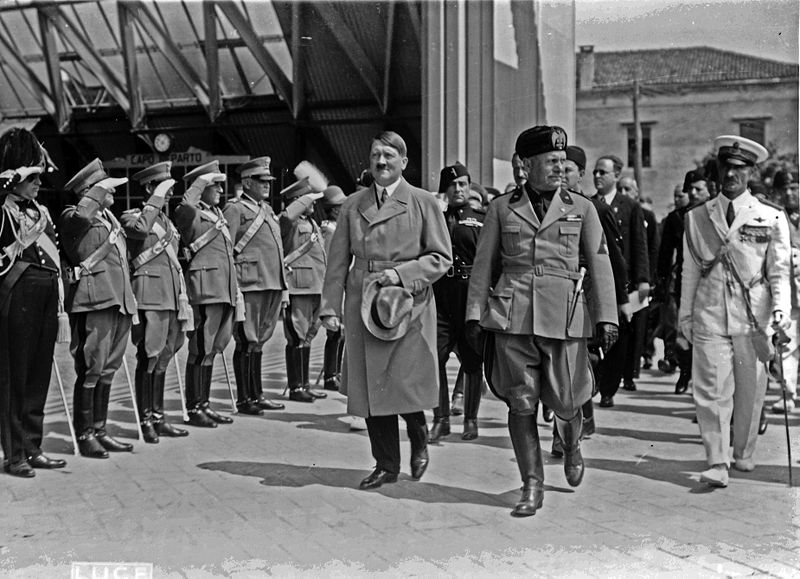
Hitler and Mussolini in Venice - 1934

Ray Goodwin and Carolyn Yeager read and comment on the July 21st-28th, 1941 dinner table monologues by the German Fuehrer, as taken down by an adjutant and checked for accuracy by Martin Bormann. Some highlights from the program:

  •  Graditude to the Jesuits for the Counter-Reformation and its Baroque architecture, leaving the Gothic behind;
  • Admiration for Mussolini and the glory of Italian art-architecture, superior to the French;
  • Martin Luther credited with replacing the many regional dialects with  the great German language;
  • English-German industrial competition and their comparison in the arts and culture;
  • The merit of the German soldier, the prestige of the SS, and the weakness of the WWI command;
  • How to control the Eastern regions with soldier-farmers as colonists;
  • Wrong to exterminate the intelligentsia, but a class system is intolerable –cannot despise the man who sweeps the streets.

Image: Adolf Hitler and Benito Mussolini walking in front of saluting military in Venice, as Hitler first arrives in Italy in 1934. (click to enlarge)

The edition being used was translated by Norman Cameron and R.H. Stevens, published by Enigma Books, New York, and can be found as a pdf here.

  • Read more about "Hitler's Table Talk" Study Hour: Episode 3
  • 1 comment
  • 882 views

"Hitler's Table Talk" Study Hour: Episode 4

By carolyn | 4:34 PM EDT, Thu March 27, 2014

Your browser does not support the audio element.

HTT_4_ 3-27-14.mp3 (13.62 MB)

March 27, 2014

German troops march past a church as they move deeper into Russia in 1941.

Carolyn Yeager and Ray Goodwin read and comment on the August 1st-10th, 1941 dinner table monologues by the German Führer, as taken down by an adjutant and checked for accuracy by Martin Bormann. Some highlights from the program:

  • Even though German functionaries are incorruptible, too much uniformity and fear of initiative is not a good thing;
  • Hitler's sympathetic attitude toward workers, and his dislike of the bourgeoisie  and the plutocracy;
  • Hydro-electric and gas works - the future will depend on water, wind and natural gas;
  • The British method of ruling their empire was not to try to Anglicize the people, but to leave them to live according to their own ways;
  • Hitler sees the combined forces of Germany, England, the Nordic countries and Italy as greater than the USA.

The edition being used was translated by Norman Cameron and R.H. Stevens, published by Enigma Books, New York, and can be found as a pdf here.
  • Read more about "Hitler's Table Talk" Study Hour: Episode 4
  • 1 comment
  • 702 views

"Hitler's Table Talk" Study Hour: Episode 5

By carolyn | 4:59 PM EDT, Thu April 03, 2014

Your browser does not support the audio element.

HTT_5_4-3-14.mp3 (13.55 MB)

April 3, 2014

Poster expressing "German thanks giving" for a good harvest. As the 30's wore on, Germany did not have enough agricultural land to feed it's growing population. But even in the 20's, Adolf Hitler saw the fertile land of Ukraine as perfect for Germany's needs.
Poster expressing "German thanks giving" for a good harvest. As the 30's wore on, Germany did not have enough agricultural land to feed it's growing population. But even in the 20's, Adolf Hitler saw the fertile land of Ukraine as perfect for Germany's needs. 

Ray Goodwin and Carolyn Yeager read and comment on the August 19 – Sept 21, 1941 dinner table monologues by the German Führer, as taken down by an adjutant and checked for accuracy by Martin Bormann. In this program:

  • Encouraging high level of births is more useful than preventing war – to kill a man before he is born is the worst;
  • The people of Europe should not be dependent upon England, but the Ukraine and Volga Basin will be the granaries for us;
  • Criminals and anarchists should be dealt with swiftly and harshly, not turned over to lawyers to get them light sentences;
  • The “spirit of decision” in deciding on Operation Barbarossa, and the quality of the German soldier as “best in the world”;
  • The industrious German nature compared to the indolent Slav nature is pointed out in several instances;
  • His dislike of the Habsburg monarchy and his gratitude to Social Democracy for sweeping all royalties away;
  • The duty of National-Socialism is to allow the best in the people to develop.

The edition being used was translated by Norman Cameron and R.H. Stevens, published by Enigma Books, New York, and can be found as a pdf here.
  • Read more about "Hitler's Table Talk" Study Hour: Episode 5
  • 1 comment
  • 1492 views

"Hitler's Table Talk" Study Hour: Episode 6

By carolyn | 4:21 PM EDT, Thu April 10, 2014

Your browser does not support the audio element.

HTT_6_4-10-14.mp3 (13 MB)

April 10, 2014

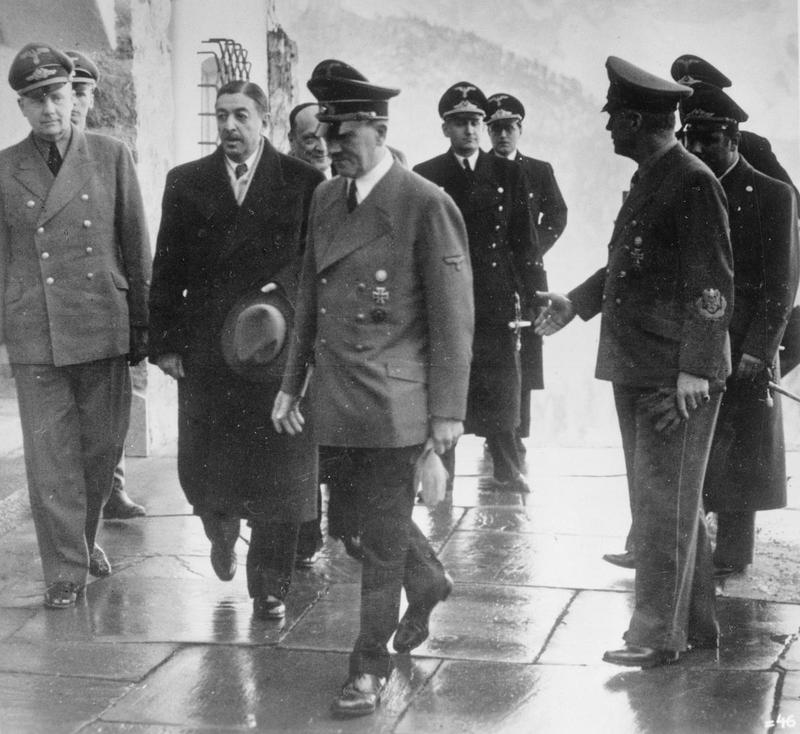
At the Obersalzberg, Adolf Hitler, accompanied by Reich Foreign Minister von Ribbentrop (right), receives the Prime Minister Zwetkowitsch of Yugoslavia for talks in February 1941
At the Obersalzberg, Adolf Hitler, accompanied by Reich Foreign Minister von Ribbentrop (right), receives the Prime Minister Zwetkowitsch of Yugoslavia for talks in February 1941 

Carolyn Yeager and Ray Goodwin read and comment on the Sept 22 to Sept. 25, 1941 dinner table monologues by the German Führer, as taken down by an adjutant and checked for accuracy by Martin Bormann. In this program:

  • The separate worlds of Europe and Asia are not marked by the Ural Mountains, but Asia penetrates into Europe without any sharp break;
  • Germany obtains the right to extend into the East by it’s awareness of what it represents – success justifies everything;
  • National-Socialism will never ape religion by establishing a form of worship;
  • The Russian soldier of the 1st World War was more good-natured than the cruel Bolshevik-led soldier of the current time;
  • The Four-Year Plan of 1936-40 with the aim of German self-sufficiency, not dependent on exports;
  • Russia as a source of raw materials for Germany and a consumer of simple German-made items such as cotton goods and household utensils.

The edition being used was translated by Norman Cameron and R.H. Stevens, published by Enigma Books, New York, and can be found as a pdf here.
  • Read more about "Hitler's Table Talk" Study Hour: Episode 6
  • 1 comment
  • 711 views

"Hitler's Table Talk" Study Hour: Episode 7

By carolyn | 11:44 AM EDT, Thu April 24, 2014

Your browser does not support the audio element.

HTT_7_ 4-24-14.mp3 (12.57 MB)
Image
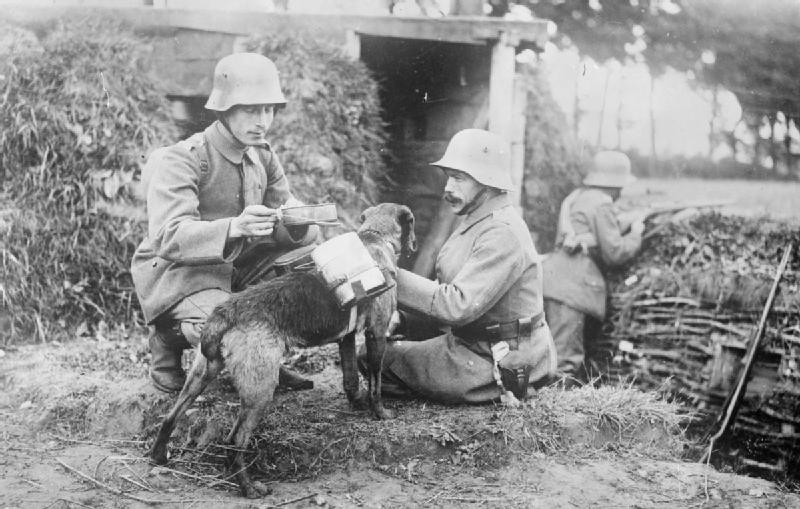
Despatch dog brings food and bullets to Geerman soldiers.
Despatch dog brings hot rations and bullets to WWI soldiers holding on to an outlying German position. How sweet is this? 

April 24, 2014

Ray Goodwin and Carolyn Yeager read and comment on the Sept.  25 to early October, 1941 dinner table monologues by the German Führer, as taken down by an adjutant and checked for accuracy by Martin Bormann. Main topics in this episode:

  • Life is a cruel struggle
  • Soldiering makes a man
  • Vienna's art treasures
  • Antonescu of Germanic origin
  • National types of Christians, and more.
     

The edition being used was translated by Norman Cameron and R.H. Stevens, published by Enigma Books, New York, and can be found as a pdf here.
  • Read more about "Hitler's Table Talk" Study Hour: Episode 7
  • 6 comments
  • 10597 views

"Hitler's Table Talk" Study Hour: Episode 8

By carolyn | 3:59 PM EDT, Thu May 01, 2014

Your browser does not support the audio element.

HTT_8_5-1-14_0.mp3 (12.97 MB)
Hitler giving signature
Looks like Adolf Hitler is paying the bill for his glass of milk and the refreshments for the rest of his party. Or else he's signing an autograph.

May 1, 2014

Carolyn Yeager and Ray Goodwin read and comment on the October 13-14, 1941 dinner table monologues by the German leader, as taken down by a trusted adjutant.

  • Economic opportunities in the East for all Northern European people;
  • Lunacy of First World War High Command;
  • How Hitler makes wise use of his time;
  • Disadvantages of a Concordat with the Churches;
  • More thoughts on Christianity.

The edition of Hitler's Table Talk being used was translated by Norman Cameron and R.H. Stevens, published by Enigma Books, New York, and can be found as a pdf here.
  • Read more about "Hitler's Table Talk" Study Hour: Episode 8
  • 12 comments
  • 4894 views

"Hitler's Table Talk" Study Hour: Episode 9

By carolyn | 1:41 PM EDT, Thu May 08, 2014

Your browser does not support the audio element.

HTT_9_5-8-14.mp3 (13.18 MB)
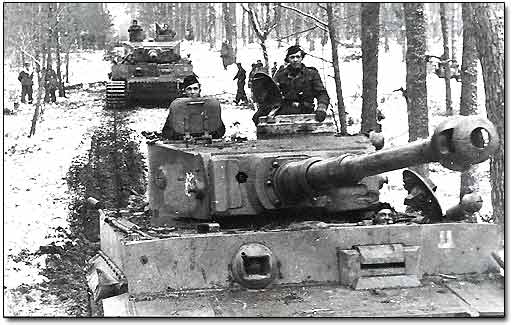
German panzer division
This picture was labeled "German panzer division heads toward Moscow in 1941" in Google Images. But I've learned it is from the end of 1943 during fighting in the Zihtomir sector. The tank is a Panzer 6 (Tiger) of SS Panzer Grenadier Division Das Reich.(see comments below)

May 8, 2014

Ray Goodwin and Carolyn Yeager read and comment on the October 14-19, 1941 dinner table conversation and monologues by the German Leader, taken down in shorthand by trusted aide Heinrich Heim. Included in this episode:

  • Suggestions for improvement of meteorological forecasts;
  • Hitler describes the challenges involved in his party's conquest of power;
  • Lesson in economics and the cause of inflation;
  • The progress made under Antonescu in Rumania, and the great promise of Ukraine;
  • May 10, 1940 (start of Western Offensive) compared to June 22, 1941 (start of Barbarossa);

The edition of Hitler's Table Talk being used was translated by Norman Cameron and R.H. Stevens, published by Enigma Books, New York, and can be found as a pdf here.
  • Read more about "Hitler's Table Talk" Study Hour: Episode 9
  • 6 comments
  • 6343 views

"Hitler's Table Talk" Study Hour: Episode 10

By carolyn | 9:34 AM EDT, Thu May 15, 2014

Your browser does not support the audio element.

HTT_10_5-15-14.mp3 (16.93 MB)

May 15, 2014

Image
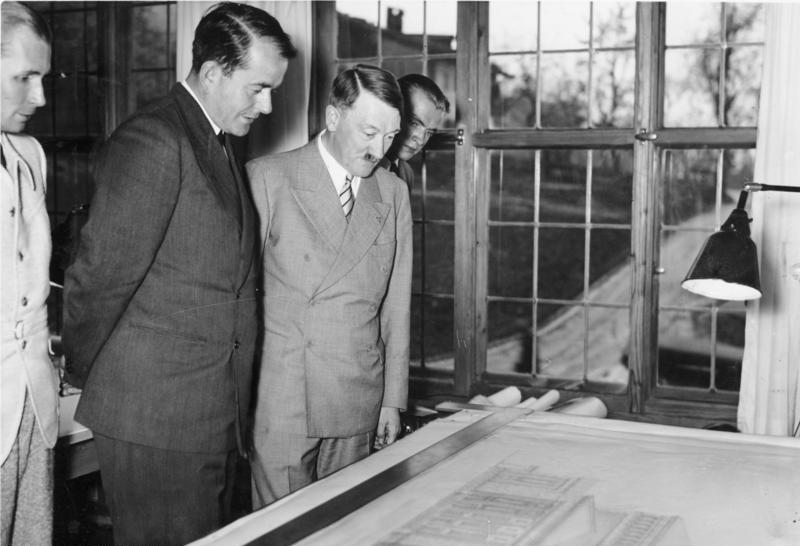
Obersalzberg, Albert Speer Adolf Hitler
Architect Prof. Albert Speer at Obersalzberg in June 1939, showing the Fuehrer his plan for the new Opera House at Linz.

Carolyn Yeager and Ray Goodwin read and comment on the October 18-22, 1941 dinner table conversation and monologues by the German Leader, taken down in shorthand by trusted aide, attorney Heinrich Heim.  Topics included in this episode:

  • Britain's oligarchic, money-grubbing politicans don't represent the people;
  • Germany needs to remain autarkic and independent from British imports even after the war;
  • Need to improve standardization of construction and building products;
  • Christianity and Bolshevism, and their relationship to St. Paul of Tarsus;
  • Hitler identifies himself as "Prussian," compares Berlin favorably to Munich;
  • Hitler: "I wish to be a builder." Monuments outlast the battles that inspired them.

The edition of Hitler's Table Talk being used was translated by Norman Cameron and R.H. Stevens, published by Enigma Books, New York, and can be found as a pdf here.
  • Read more about "Hitler's Table Talk" Study Hour: Episode 10
  • 9 comments
  • 5413 views

"Hitler's Table Talk" Study Hour: Episode 11

By carolyn | 12:17 PM EDT, Thu May 22, 2014

Your browser does not support the audio element.

HTT_11_5-22-14.mp3 (19.38 MB)

May 22, 2014

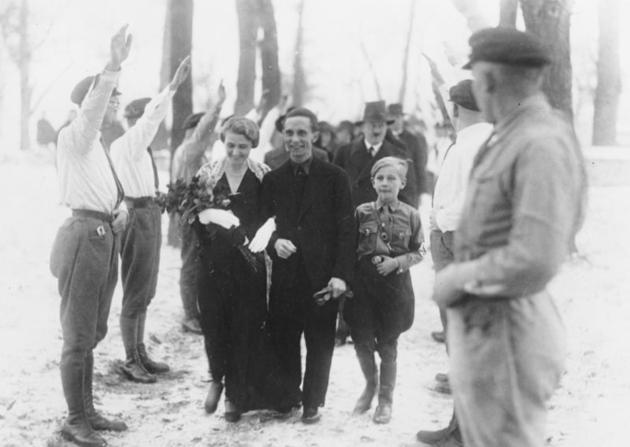
Joseph Goebbels on his wedding day in Dec. 1931
Joseph Goebbels on his wedding day in Dec. 1931, with Magda's 10 yr. old son walking beside him. Hitler, walking behind dressed in coat and hat, was best man. The Church put Goebbels under a ban for marrying a Protestant, but he still had to pay the church tax.

Carolyn Yeager and Ray Goodwin read and comment on the October 24-30th, 1941 dinner table conversation and monologues by the German Leader, taken down in shorthand by trusted aide, attorney Heinrich Heim.  Topics included in this episode:

  • Religion and the Church versus science;
  • The beauties of the Ancient World and the destruction of antiquity and the past;
  • The fate of Europe's Jews for their responsibility in bringing on war;
  • Vision of a strong and great Europe with the addition of Ukraine;
  • Thoughts on motorized war, the qualities of Croatians, National-Socialism, training of teachers, the art and culture of Paris;
  • A number of distinguished guests were present at these meals.

The edition of Hitler's Table Talk being used was translated by Norman Cameron and R.H. Stevens, published by Enigma Books, New York, and can be found as a pdf here.
  • Read more about "Hitler's Table Talk" Study Hour: Episode 11
  • 20 comments
  • 15756 views

"Hitler's Table Talk" Study Hour: Episode 12

By carolyn | 1:45 PM EDT, Thu May 29, 2014

Your browser does not support the audio element.

HTT_12_5-29-14.mp3 (15.41 MB)

May 29, 2014

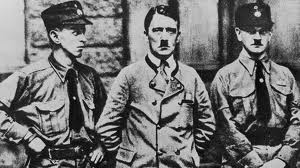
Hitler paramilitary wing 1923
Hitler stands with two members of his paramilitary wing in 1923, men he remembers as "jolly rogues" who were invaluable to him because of their willingness to sacrifice.

Carolyn Yeager and Ray Goodwin read and comment on the October 30-November 2, 1941 dinner table conversations and monologues by the German Leader, taken down in shorthand by trusted aide, attorney Heinrich Heim.  Topics included in this episode:

  • The Fuehrer discusses a hunting-trip taken by some of his Ministers and Reichsleaders;
  • Sharp criticism of the Foreign Office for its lack of ingenuity;
  • For high officials, the interests of the State and private investment conflict;
  • Plan to improve the Civil Service and Judiciary;
  • Social justice before everything - Masses are the source of the elite - Soldiers recognize a commander.

The edition of Hitler's Table Talk being used was translated by Norman Cameron and R.H. Stevens, published by Enigma Books, New York, and can be found as a pdf here.
  • Read more about "Hitler's Table Talk" Study Hour: Episode 12
  • 2 comments
  • 2194 views

"Hitler's Table Talk" Study Hour: Episode 13

By carolyn | 4:07 PM EDT, Thu June 05, 2014

Your browser does not support the audio element.

HTT_13_6-5-14.mp3 (13.65 MB)

June 5, 2014

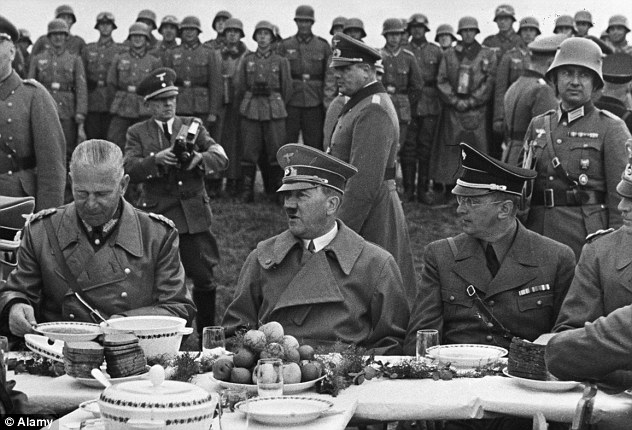
Hitler at a soldier's meal
Hitler talks about the effect of diet on disease in this episode. Here he dines out of doors with his officers as ordinary soldiers look on; the short officer in the background must be Helmuth Stieff, later executed for treason. They are having soup (a Führer favorite) with fresh fruit on the table. 

Ray Goodwin and Carolyn Yeager read and comment on the Nov. 2nd-6th 1941 dinner table monologues by the German Leader, as taken down in shorthand by trusted aide, attorney Heinrich Heim. Topics included in this episode:

  • The dimensions of Europe have changed over the years;
  • Criminals cannot be tolerated in society during wartime but juvenile criminals need special treatment;
  • Diet and long life, and freedom from disease;
  • Progress of the Germanic race and peculiarities of the Jewish mind;
  • Standards for promotion, and fairness in handing out awards

The edition of Hitler's Table Talk being used was translated by Norman Cameron and R.H. Stevens, published by Enigma Books, New York, and can be found as a pdf here.
  • Read more about "Hitler's Table Talk" Study Hour: Episode 13
  • 4 comments
  • 7424 views

"Hitler's Table Talk" Study Hour: Episode 14

By carolyn | 4:21 PM EDT, Thu June 12, 2014

Your browser does not support the audio element.

HTT_14_6-12-14.mp3 (17.38 MB)

June 12, 2014

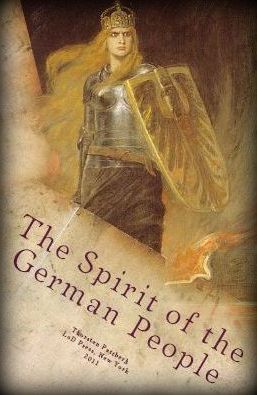
Spirit of the German People

Carolyn Yeager and Ray Goodwin read and comment on the November 11th-16th, 1941 dinner table conversations and monologues by the German Leader, taken down in shorthand by trusted aide, attorney Heinrich Heim.  Some highlights of this episode:

  • Monarchy is an out-of-date form - example, the Thuringian Royal House lived off the state;
  • Keeping the friendship of the Church is too costly, but we're glad to have its cultural monuments - the great Cathedrals;
  • Frederick the Great's reaction against the Church in defense of the State was definitive;
  • The Germanic Spirit will penetrate the East and bring the people all they need;
  • The success of the Four Year Plan is explained by setting everybody to work within a closed circle economy, not by rearmament;
  • Too many officials, too much paperwork - Hitler wants more local autonomy;
  • Legal system is too lenient; there are no "extenuating circumstances" for treason.

The edition of Hitler's Table Talk being used was translated by Norman Cameron and R.H. Stevens, published by Enigma Books, New York, and can be found as a pdf here.
  • Read more about "Hitler's Table Talk" Study Hour: Episode 14
  • 8 comments
  • 3528 views

"Hitler's Table Talk" Study Hour: Episode 15

By carolyn | 11:38 AM EDT, Thu June 19, 2014

Your browser does not support the audio element.

HTT_15_6-19-14.mp3 (18.27 MB)

June 19, 2014

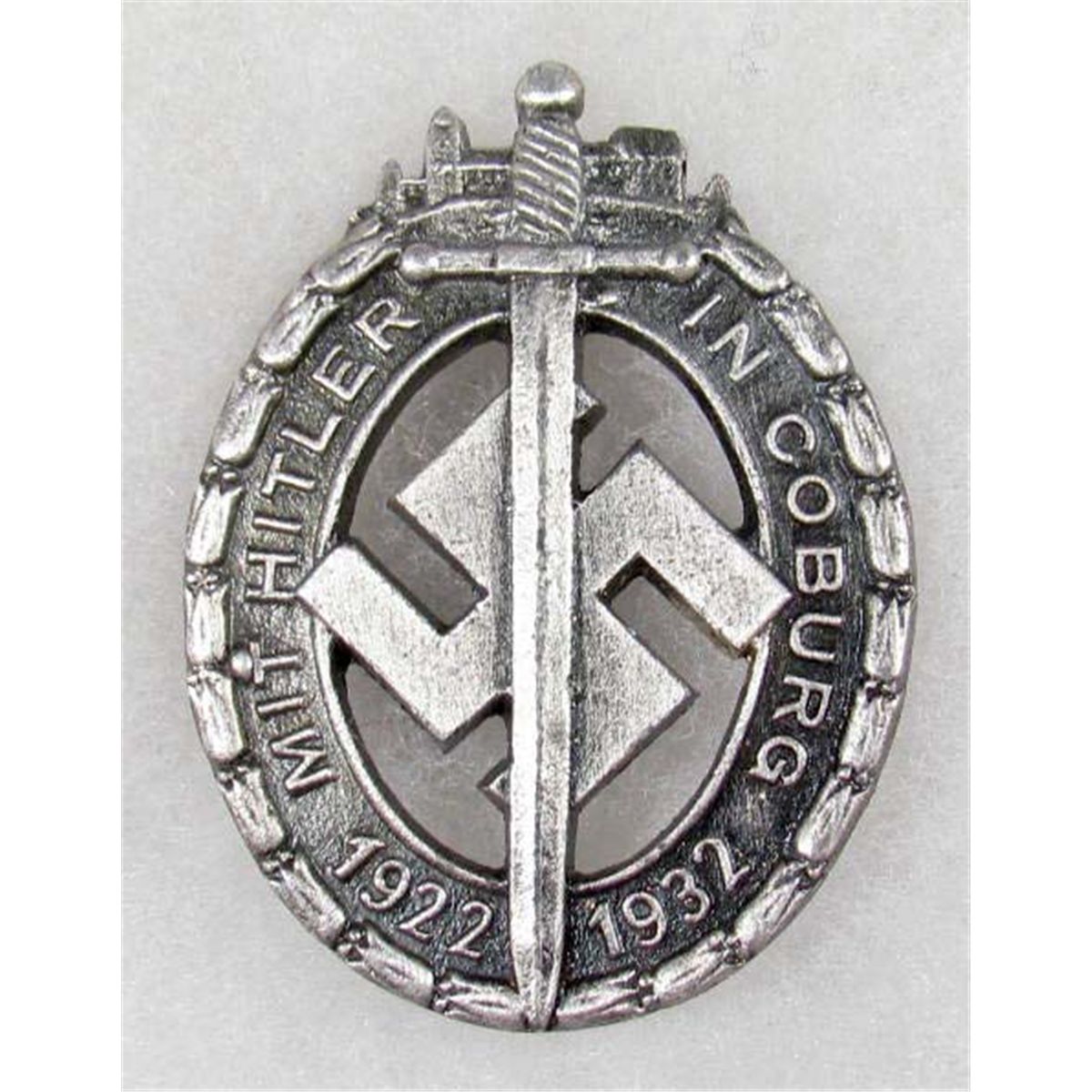
Coburg Badge
Hitler ordered the Coburg Badge to be struck on October 14, 1932 to memorialize the event which took place ten years earlier. In Nov. 1936, he listed the top NSDAP awards  in this order: 1. Coburg Badge; 2. Nürnberg Party Badge of 1929; 3. SA Treffen at Brunswick 1931; 4. Golden Party Badge; 5. The Blood Order

Ray Goodwin and Carolyn Yeager read and comment on the Nov. 19th-Dec. 14th 1941 dinner table monologues by the German Leader, as taken down in shorthand by trusted aide, attorney Heinrich Heim. Topics included in this episode:

  • The Struggle for Power, the necessity to follow Nature's laws, and the peculiar German sense of duty;
  • Hitler tells stories about the Party's trip to Coburg in 1922, the Volkischer Beobachter NSDAP newspaper, and the reason for uniforms;
  • On Germans married to Jews, and the Jewish role as a destroyer;
  • Highest aim of every man should be the preservation of the species;
  • Catholic Church better at appreciating culture and beauty than the Protestant.

The edition of Hitler's Table Talk being used was translated by Norman Cameron and R.H. Stevens, published by Enigma Books, New York, and can be found as a pdf here.
  • Read more about "Hitler's Table Talk" Study Hour: Episode 15
  • 22 comments
  • 3898 views

"Hitler's Table Talk" Study Hour: Episode 16

By carolyn | 11:11 AM EDT, Thu June 26, 2014

Your browser does not support the audio element.

HTT_16_6-26-14.mp3 (17.91 MB)

June 26, 2014

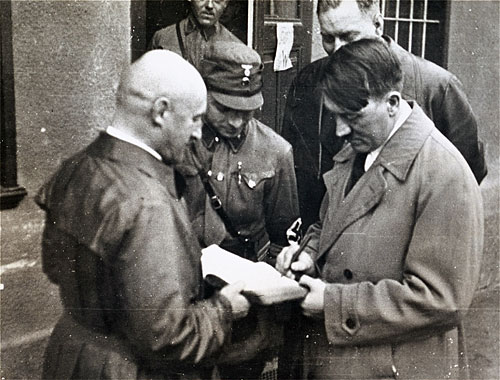
Adolf Hitler and Julius Streicher
Adolf Hitler in pre-Chancellor days, signs something for Julius Streicher, NSDAP Gauleiter of Nuremberg.

Carolyn Yeager and Ray Goodwin read and comment on the Dec. 17-31, 1941 dinner table monologues by the German Leader, as taken down in shorthand by trusted aide, attorney Heinrich Heim. Some highlights of this episode:

  • Hitler tells stories about Karl Lueger and Georg von Schoenerer of Vienna, plus other mayors of German cities;
  • The difficulty of building an art collection when Jews are dishonest dealers - finding the Bordone Venus;
  • More on how cooked food causes disease, and the achievements of the Party men;
  • Hitler defends Julius Streicher, who has been removed as Gauleiter of Nuremberg - says Dietrich Eckart had also thought men like Streicher were necessary;
  • Hitler treats his political opponents well;
  • Ruhr industrial district - the need for increased production of coal and iron;
  • Some thoughts on the Japanese. 
  • Read more about "Hitler's Table Talk" Study Hour: Episode 16
  • 2 comments
  • 2379 views

"Hitler's Table Talk" Study Hour: Episode 17

By carolyn | 10:19 PM EDT, Thu July 03, 2014

Your browser does not support the audio element.

HTT_17_7-3-14.mp3 (19.32 MB)

July 3, 2014

Image
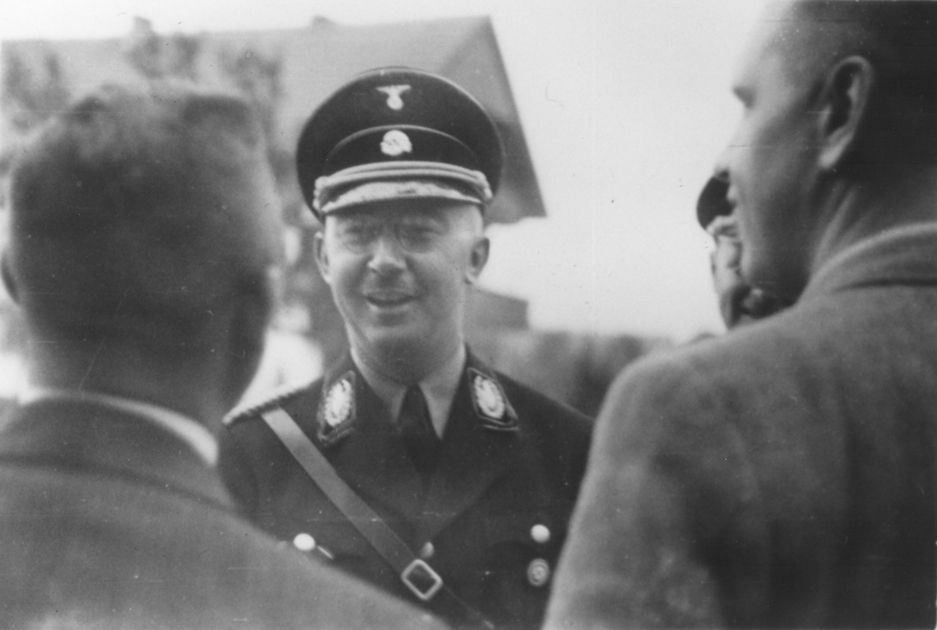
HImmler
Hitler calls Heinrich Himmler "our Ignatius de Loyola" who "with intelligence and obstinacy forged the instrument of the SS" to become "that extraordinary body of men."

Ray Goodwin and Carolyn Yeager read and comment on the dinner table monologues by the German Leader from Jan. 1st to 5th, 1942, as taken down by trusted aide Heinrich Heim.  Included in this episode:

  • The importance of that which transcends understanding and the inspiration received at Obersalzberg;
  • The sacrifice demanded of the SS and other elite forces and the extraordinary qualities of Heinrich Himmler;
  • The personality of Sepp Dietrich and the leadership of Goering and Viktor Lutze;
  • The importance of optimism and comparison of the American, English and Russian soldier;
  • The meaning and importance of the title "Fuehrer";
  • The three great mistakes of the Italian High Command and the future of tank warfare.

The edition of Hitler's Table Talk being used was translated by Norman Cameron and R.H. Stevens, published by Enigma Books, New York, and can be found as a pdf here.
  • Read more about "Hitler's Table Talk" Study Hour: Episode 17
  • 3 comments
  • 2454 views

"Hitler's Table Talk" Study Hour: Episode 18

By carolyn | 10:21 PM EDT, Thu July 10, 2014

Your browser does not support the audio element.

HTT_18_7-10-14.mp3 (20.4 MB)

July 10, 2014

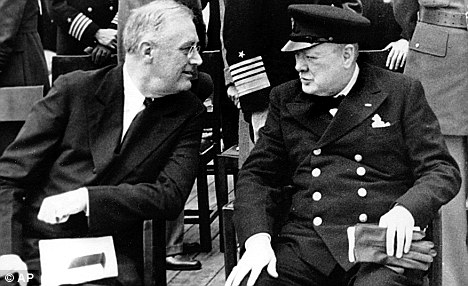
Churchill and Roosevelt first meeting 1941
Franklin Roosevelt and Winston Churchill face to face for the first time in 1941. Hitler despised them both.

Carolyn Yeager and Ray Goodwin read and comment on the Jan. 5th-7th, 1942 dinner table monologues by the German Leader, as taken down in shorthand by trusted aide, attorney Heinrich Heim. Some highlights of this episode:

  • Japan and the Jews, the stupid Americans, the Spanish soldier;
  • Stalin identifies with the Tsars and Pan-Slavism more than Boshevism - Slavs and Asians can copy but not invent;
  • Corruption in Freemasonry, fictitious wealth of gold, guilt of Jews;
  • Changes at Rome, Hitler removes Brauchitsch as Army chief;
  • Churchill's faults, the decline of England, the decay of America.

The edition of Hitler's Table Talk being used was translated by Norman Cameron and R.H. Stevens, published by Enigma Books, New York, and can be found as a pdf here.
  • Read more about "Hitler's Table Talk" Study Hour: Episode 18
  • 5 comments
  • 2115 views

"Hitler's Table Talk" Study Hour: Episode 19

By carolyn | 10:27 PM EDT, Thu July 17, 2014

Your browser does not support the audio element.

HTT_19_7-17-14_0.mp3 (20.34 MB)

July 17, 2014

Image
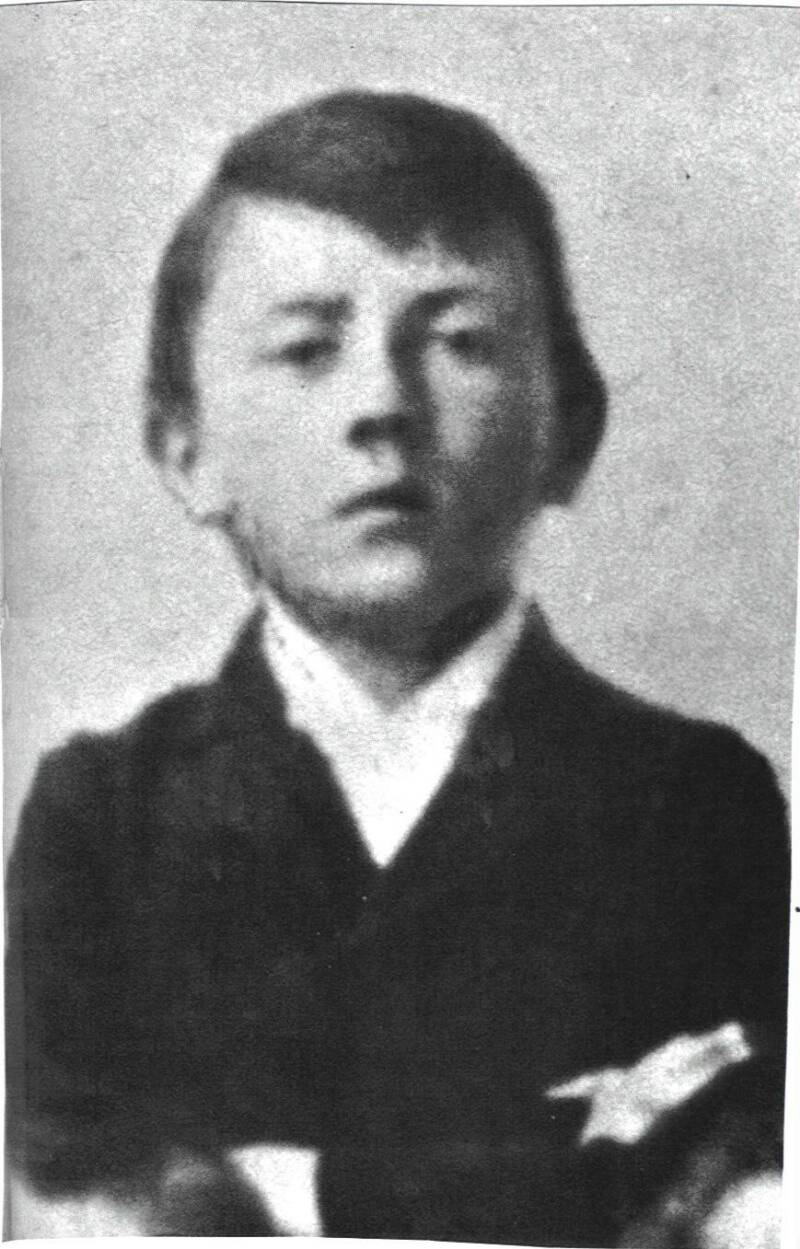
Hitler as a boy.
The schoolboy Adolf Hitler - never a dull moment.

Ray Goodwin and Carolyn Yeager read and comment on the dinner table monologues by the German Leader from Jan. 8-13, 1942, as taken down by trusted legal aide Heinrich Heim. Included in this episode:

  • Hitler reminisces about schoolboy pranks and other youthful experiences;

  • More reminiscences about the dangers of airplane travel, plus campaigning by air vs motor-car in 1931-32, and building autobahns in the East;

  • Japan's sudden wealth, plus Britain's wealth is in India;

  • Discussion of following orders and supply problems on Eastern Front, plus better preparations for foreign conditions in the future;
     
  • Churchill's policies favor no one but Jews, and how the British rule India.

The edition of Hitler's Table Talk being used was translated by Norman Cameron and R.H. Stevens, published by Enigma Books, New York, and can be found as a pdf here.
  • Read more about "Hitler's Table Talk" Study Hour: Episode 19
  • 10 comments
  • 2033 views

"Hitler's Table Talk" Study Hour: Episode 20

By carolyn | 5:31 PM EDT, Thu July 24, 2014

Your browser does not support the audio element.

HTT_20_7-24-14.mp3 (20.3 MB)

July 24, 2014

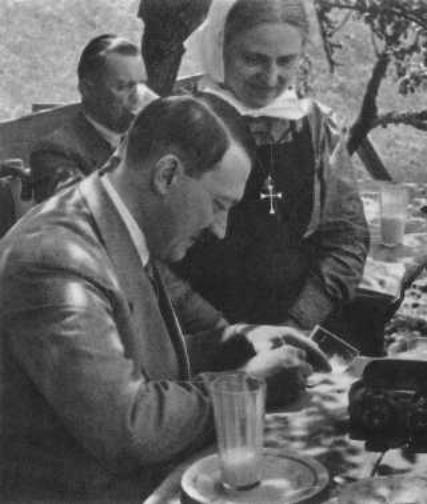
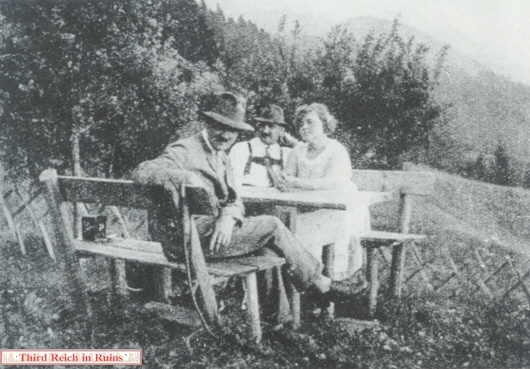
Hitler with Bruno Buchner and wife
At the Hochlenzer Gasthaus (restaurant) in Berchtesgaden, Adolf Hitler sits at an outdoor table with Bruno Buchner and his wife, proprietors of the Platterhof Hotel, Obersalzburg.

Ray Goodwin and Carolyn Yeager read and comment on the Jan. 13-17, 1942 dinner table monologues by the German Leader, as taken down in shorthand by trusted aide, attorney Heinrich Heim. Included in this episode:

  • Hitler talks about Czechs in general and Emil Hacha in particular;
  • Men of genius like Austrian composer Anton Bruckner, who was unappreciated for so long, must be encouraged;
  • High birthrate at the time in India, in Russia, but also in Germany;
  • A woman of genius: Angelica Kauffmann was a very great painter, says Hitler;
  • The early days in Obersalzberg wth Dietrich Eckart - he was known only as Herr Wolf until he began giving public speeches - how he bought his house "Wachenfeld";
  • Recalls the many friends from those days, which were the best days in his life, and how he enjoyed the ladies and pretty girls;
  • Hitler mentions "the second volume of my book" being written in the Deutsche Haus in Berchtesgaden;
  • Praises Dietrich Eckart, calls him the "polar star" to the early National Socialists and his death a great loss.

The edition of Hitler's Table Talk being used was translated by Norman Cameron and R.H. Stevens, published by Enigma Books, New York, and can be found as a pdf here.
  • Read more about "Hitler's Table Talk" Study Hour: Episode 20
  • 5 comments
  • 1672 views
Pagination
  • Current page 1
  • Page 2
  • Page 3
  • Next page Next ›
  • Last page Last »

My Articles

  • Early Articles
  • The Third Reich
    • Hans-Ulrich Rudel: The man who might have been the next German Führer
    • The Search for WWII Mass Graves
    • The Fake Legends of Adolf Hitler’s “Jewish Grandfather”
    • Latest expression of virulent Jewish hatred: Hitler's parents' grave destroyed
    • The Gleiwitz “False Flag” Incident is Pure Fiction
    • Nuremberg hangman was a U.S. Navy-diagnosed psychopath who slowly strangled top Nazis
  • Heroic Women
    • Hanna Reitsch – warrior of flight and freedom
    • The Mothers Movement - Agitating Against American Involvement in World War II
    • Florence Rost Van Tonningen
  • Holo Frauds and Quacks
    • Zisblatt: A Special Jewel
    • "Diamond Girl" Fiction
    • Second Response to J. Neander
    • Denis Avey: Man Who Would Be Righteous
    • Avey, BBC ,and British Government
    • Why BBC and Labour Backed Avey Hoax
    • Pedophile Promotes Denis Avey Hoax
    • The Shadowy Origins of Night
    • Elie Wiesel and the Mossad, Part 1
    • Elie Wiesel and the Mossad, Part 2
    • Elie Wiesel and the Mossad, Part 3
    • Elie Wiesel and the Mossad, Part 4
    • Septuagenarian’s “Holocaust” memories dangerous to youth, wrong as history
    • “Child survivor” Paul Argiewicz and the missing five years
    • Time to call Ken Waltzer a fraud?
    • Max Hamburger Says He Is the ‘Zombie Man’
    • Naftali Fürst claims to be in Famous Buchenwald Photo as a 12-year-old boy
    • Martin Gray: Another Polish Jew surlievor*
    • Yehuda Bacon memoir at Elie Wiesel Cons The World
    • History teacher who outed holocaust fraudster Joseph Hirt calls for apology or prosecution
  • More Holocaust Revisionism
    • Jewish population figures don't add up
    • My response to Alan Dershowitz's essay “The origin of fake news in holocaust denial” published at Gatestone Institute
    • Hungarian Deportation: An Objectivity Lesson
    • Thoughts on the Jewish Problem and the HoloHoax
  • World Jewish Congress
    • Fake Documents Supporting Auschwitz Hoax
    • The Hoax that won't die
    • History of the World Jewish Congress
    • Critic: It's not just the Jews
    • Circular Reasoning and the Holocaust
  • Special Treatment for Jews
    • Stop Special Treatment for Jews – a way forward
    • New Jersey authorities expose Jewish welfare fraud
    • How Orthodox Jewry is robbing an American town
    • Religion is key to Lakewood's 'special treatment' for Jews
    • New Jersey rabbis face prison in kidnapping conspiracy
    • Explosive growth of the ultra-Orthodox community in Lakewood
    • Lakewood's woes: Jews create chaos in Gentile societies
    • Lakewood Orthodox welfare cheats offered amnesty
    • Large Orthodox Jew families are an unfair burden for schools
    • Rapid growth of Orthodox population creating havoc in NY-NJ
    • Orthodox clinic owner steals $7 mil from Medicaid
    • Mosberg indicted in 2008 on corruption, bribery charges
    • New Jersey town's losing battle to prevent Orthodox Jewish takeover
    • Seven NY Orthodox in $14 million scam to steal school money
    • Brooklyn clinic owned by Orthodox Jews investigated for vaccine fraud
    • Fox News on problems Hasidic Jews bring to U.S. communities
  • Movement Controversies
    • Kevin MacDonald on record saying whether the Holocaust actually happened is “not important”
    • Greg Johnson echos Kevin MacDonald in opposing 'Holocaust' revisionism - One must ask why
    • Everything Greg Johnson knows about Holocaust Revisionism he learned from Mark Weber
    • The Unforgivable Sins of Mark Weber
    • The Goebbels-Vlasov-Irving Question
    • The Goebbels-Vlasov-Irving Question, Part 2
    • The Rise and Fall of Tribal Administrator Rodney Martin

Ein Anderer Hitler

  • The Battle of the Architects
    • Giesler on Speer: The Battle of the Architects
    • Battle of the Architects, Part 2
    • Battle of the Architects, Part 3
    • Battle of the Architects, Part 4
    • Battle of the Architects, Part 5

Buy this book here or here

Wenger Family Archive

  • Willy Wenger's Writings
    • Childhood
    • The great hope: The German Reich
    • Referendum of April 10th, 1938; 1939 & the Napola School
    • The Odyssey of Fahnenjunker Wenger (part one)
    • The Odyssey of Fahnenjunker Wenger (part two)
    • Albin's Story
    • The Final Flight of Poldi Wenger - April 10, 1945
    • The Passing of an Era – Remembering Willy Wenger 1926-2017
  • Leopold Wenger
    • Hitler Youth
      • Out and About on the Bicycle 1936-37
      • Great Ride to Nuremberg for 1937 N-S Party Convention
      • The Days of Our Revolution 1938
    • Napola Letters
      • April-May 1939
      • May-June 1939
      • July-November 1939
    • Wartime Service
      • Letters from Nov. 1939-April '40
      • Letters from April-Dec. 1940
      • France: January-April 1941
      • France, May-December 1941
      • France, February - July 1942
      • France, July-December 1942
      • France, January-June 1943
      • Sicily and Lake Constance, June-Nov. 1943
      • Eastern Front, Nov 1943-Feb 1944
      • Ukraine-Bessarabia, March-June 1944
      • Last letters from Eastern Front, Aug. 1944-Jan. 1945
      • A close encounter between wartime rivals only revealed 74 years later
  • Wenger Family Archive Index

The German Reich

  • Hostility towards Germans
    • The Anti-German Narrative in the West
    • German Self-Hatred and Leftist Ideology
    • White Guilt and Islamic Chauvinism
    • Britain's 100 year war against Germany
    • Searching for the roots of persistent anti-Germanism
    • Final Interview With Erich Priebke
    • Interview: Horst Mahler on the German Reich
    • Interview: G. S. Viereck's 1923 interview with Adolf Hitler
    • Odeonsplatz: Interview with Werner Bräuninger
  • Law & Government
    • Kristallnacht
      • A closer look at Kristallnacht 1938 - Jewish hoax?
      • Assassination and terror is the method of Jewish ethnic warfare
      • The Jewish Declaration of War
      • What really happened on November 9, 1938 in Munich
      • Damage from 'Kristallnacht' greatly overstated by world press
      • Psychological warfare operations explain 'Kristallnacht'
      • Ingrid Weckert considers 'Cui Bono?' – Who benefited from Kristallnacht?
      • Pegida-Dresden, Tatjana declares guilt complex over!
      • 75 Years after "Kristallnacht"
  • National Socialism
    • Mein Kampf, vol. I
      • On 'Public Opinion'
      • On 'The Majority Principle'
      • On 'Jewish Democracy' and 'The Importance of the Spoken Word'
      • On Connecting With The Mass and The 'Away-From-Rome' Movement
      • On 'Defects in our Educational System' and 'Concentration on a Single Enemy'
      • On 'Anti-Semitism On a Religious Basis'
      • On 'State and Economy'
      • On 'The Moment of Decay'
      • Adolf Hitler on 'The World War'
      • On 'The World War' part 2
      • On 'The World War' part 3
      • On 'War Propaganda'
      • On Discovering Gottfried Feder
      • On How He Joined the DAP
      • On 'Causes of the Collapse'
      • On 'Causes of the Collapse', part 2
      • On 'Causes of the Collapse', part 3
      • On 'Causes of the Collapse', part 4
      • On 'Nation and Race'
      • On 'Nation and Race', part 2
      • On 'Nation and Race', part 3
    • Mein Kampf, vol. II
      • On the Political Meaning of 'Folkish'
      • On The State, part 1 - Germanization
      • On The State, part 2 – Nature and Purpose
      • On The State, part 3 – Racial Hygiene and Physical Education
      • On The State, part 4 - Needed changes in education
      • On The State, part 5 - Selecting talent over social class
      • On Subjects and Citizens in the National Socialist State
      • On Personality and the Folkish State-Concept
      • On the Early Struggle: Significance of the Spoken Word
      • On Worldview and Organization of the Folkish State
      • On Conflict With the Red Front
      • On Conflict With the Red Front, part Two
      • Why the Strong Man is Mightiest Alone
      • Regarding the Meaning and Organization of the S.A. (Part One)
      • Regarding the Meaning and Organization of the S.A. (Part Two)
      • Regarding the Meaning and Organization of the S.A. (Part Three)
      • The Mask of Federalism
      • Propaganda and Organization
      • The Trade Union Question
      • German Post-War Alliance Policy
      • Germany's Policy in Eastern Europe, Part One
      • Germany's Policy in Eastern Europe, Part Two
      • The Right to Emergency Defense
  • Führer Speeches

Race & History

  • Ancient Aryan History
  • Race in Civilization
    • The Importance of Race in Civilization
    • Why are you obsessed with race? What is your agenda?
    • The Racial Awakening of the German People by Dr. Rudolf Frercks, parts 1-3
    • The Racial Awakening of the German People by Dr. Rudolf Frercks, parts 4-8
    • The Racial Awakening of the German People by Dr. Rudolf Frercks, parts 9-10
  • World War I
    • The Fatherland
      • The Fatherland weekly covered The Great War in Europe from a German-American perspective
      • Lying during war: A sampling from “The Fatherland”
      • Who were the lawbreakers? Who were the liars?
      • Further reports on criminal treatment of German-Americans by England
      • Did you know? Excerpts from “The Fatherland” reveal insights into Great European War
      • The state of American neutrality in February 1915
      • An essay on English transgressions vs the will of Providence
      • Did the US-UK alliance against Germany-Austria begin long before 1917?
      • The Lusitania tragedy turned into pretext for US to enter war
      • Striking examples from The Fatherland that support the One War thesis
      • In September 1915, German-Americans still perceived as lesser Americans
      • Why the Money Trust wanted war: The British "Gold Plot"
      • More on the Money Trust—The American Pilgrims Society
      • The Brussels documents and the heresy of Woodrow Wilson
      • In 1916, Wilson Administration drops façade of neutrality; attacks German Americans
      • Henry Ford and Cecil Rhodes, on opposite sides, make news in The Fatherland
      • An Exchange of Letters bearing on the British Ideal of Cecil Rhodes
      • America moves closer to war; Wilson unhappy with conciliatory German Note
      • Outnumbered German Fleet bests the British in the great Battle of Skagerrack
      • Political parties choose their 1916 nominees: Hughes and Wilson
      • The submarine Deutschland makes surprise visit to America!
      • The Kaiser answers his American attacker
      • Zeppelins strike fear in English towns and ports
      • Wilson's reelection advances Anglo-American alliance against Germany
      • 'The Fatherland' exposes ruthlessness of US conduct of Philippine War under Germany-critic Elihu Root
      • More revelations of Anglo-American crimes as condemnation is heaped on Germany
      • Wilson addresses Senate; proposes Monroe Doctrine 'for the world'
      • Talk of peace in January 1917 raises hopes, proves deceptive
      • Little hint yet of dramatic events about to break
      • Wilson breaks relations with Germany; 'The Fatherland' takes new name
      • Final installment from The Fatherland—Germany enforces total U-boat blockade
  • World War II
  • Hitler and the Slavs

Women & Family

  • Five Race Conscious Women
  • For and About Women
  • Health
  • Heroic Women
  • Home Schooling
    • A Family Mission Statement
    • Home Schooling News
    • Top 100 homeschool websites
    • The Salina, Kansas Exam
    • History for Kids
  • Links to Other Motherhood Articles

Art & Culture

  • Art News
  • Carolyn's Ancestry
    • History of Sant Anna
    • My DNA results
    • This is Larry Kahant

JAN27
International Day of Commemoration in Honor of the Revisionists Who Introduced Sanity to the Auschwitz “Death Camp” Narrative
 

User menu

  • Log in
  • Reset your password

Copyright © 2026 Company Name - All rights reserved