

The book that every student of Hitler needs to own …
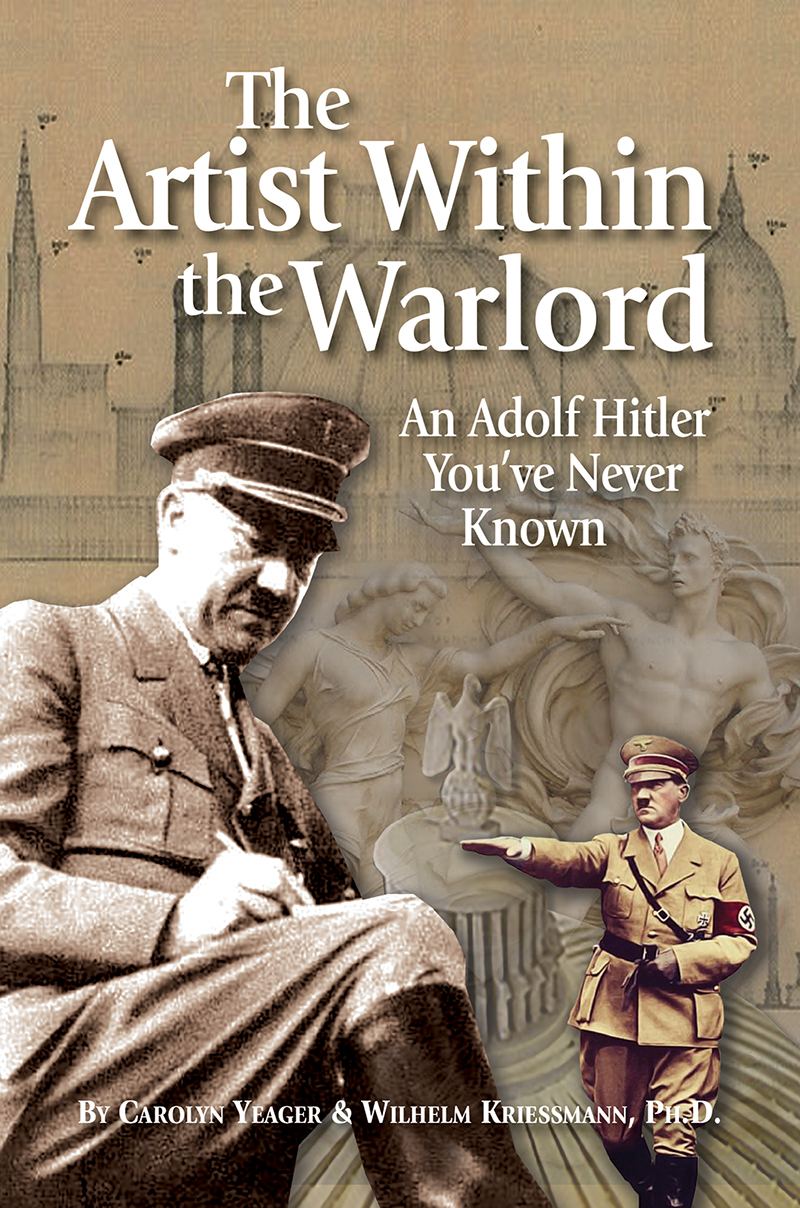
The collected translations and commentary by Wilhelm Kriessmann, Ph.D. and Carolyn Yeager from Hermann Giesler's German-language memoir Ein Anderer Hitler.
A wealth of insight into the REAL HITLER awaits you in this new book that puts it all together in thirteen revealing chapters that lay out the world view and the unique personality of the most controversial leader of the twentieth century. Hitler the artist ... Hitler the humanist … Hitler the persistent planner ... are three of the aspects of Adolf Hitler you will learn about, or learn more about, in this book. [See special announcement below with the ordering information.]
You may have already read the selections when they appeared in The Barnes Review from Dec. 2008 through June 2011. Or you may have read them when they appeared on this website. But, as I myself experienced when seeing the chapters together in book form for the first time, you will be struck by the greater clarity in which you perceive not only the man but the surrounding details of history from 1939 to 1945 that Hitler was intimately involved with. It is solid history that we can rely on because we can rely on Hermann Giesler. As an honest admirer and friend of Adolf Hitler, he faithfully reported what he saw and heard during his time spent at Obersalzberg and at the secret headquarters of Wolfschaanze in East Prussia and Werwolf in Ukraine. He probably jotted down notes after his many meetings with the Fuehrer.
Though this new book refers to Hitler the artist, that designation is not determined by the paintings and drawings created by young Adolf in Vienna and Munich, but by his sensitivity to, and the importance he placed on Art in the life of a nation. His own artistic ability (he always said if he had not become a politician – and that was because he believed Germany needed him – he would have become a famous architect) certainly influenced the importance he placed on city building projects, some of which he had been thinking about since his youth. It's also why he needed to remain involved in such projects.
Seeing the world around him through the eyes of an artist also explains why the National Socialist party buildings and events were so visually well designed with flags, banners, decorative reliefs and attractive uniforms, with impressive outdoor rallies featuring thousands of participants and dramatic nighttime lighting displays. No one else has ever achieved the integration of art with politics in the masterful way Hitler did.
Yet, this book remains mainly about Hitler the political and wartime leader and planner because that is what Giesler thought important to relate for history. Even so, as a prize-winning architect Hermann Giesler naturally picked up on the artist in Hitler and it comes through on page after page of his memoir. Hitler the humanist also comes through clearly, and often in combination with a modesty of demeanor unexpected in the Fuehrer. What we don't find is either 'Hitler the overwrought screamer' or 'Hitler the cold-blooded executioner' because that Hitler didn't exist, and there was no hint between the two men of the mythical “war crimes,” nor any mention of such by the inner circle at headquarters.
To order your copy, go to this page. Or call 1-877-773-9077 toll free between approximately 10 am and 5 pm Mon.-Fri. 6"x9", 244 pages, $25 plus $5 S&H inside U.S.
Special announcement: A certain portion of the first order of books were inadvertently trimmed too small in the bindery process. If the book you paid for is less than a full 6" by 9" (an eighth to a quarter inch less in height and width), please let me know by email [[email protected]] or in the contact section, and TBR will send you a replacement copy. Just give me the name you ordered the book under. Sorry for the oversight, but I want everyone to have a perfect book and so does the publisher.
- 1628 views
Comments (28)
Just placed my order
JoeG
I'm really looking forward to reading this book!
Thanks JoeG. I don't think
carolyn
Thanks JoeG. I don't think you'll be disappointed. However, let me know what you think after you read it, or begin to read it, right here in this space. Questions will be okay too. I'm looking forward to a good discussion.
Questions
Joey Virgo
Carolyn,
I'm on page 38, Chapter 2, and I have this question as to where the Geisler text begins and ends and where the translator and you come in. Sometimes there is the sign "Translator's Note" but clearly there is text that has no sign and yet cannot be part of Geisler's text - unless I'm entirely wrong. I find the blending or run-in narration between Geisler and non-Geisler a little disconcerting because unconventional. Otherwise, I'm enjoying the reading experience thus far. The Napoleon meme in Hitler's thinking is wonderful and his trust in certain leaders doing the right thing makes him so real and human that I wish the general public could see the man through Geisler's porthole. It's up to you whether you want to post this comment, of course. I'm mainly just interested to learn your viewpoint on how the narration flows in the text.
A very good question that I'm
carolyn
A very good question that I'm happy to answer. In Chapter two, for our commentary, we used the device of taking a quote from Giesler's text to head each article of commentary. So only the quote on page 38-39 is Giesler and, following the astericks, is Wilhelm and me.
You wil find some minor differences in handling from one chapter to the next (but not much) because it originally appeared in TBR magazine in 14 installments, two months apart. I didn't change too much because I want the book to remain what Willi and I did together, not re-do it on my own. There could be no end to that, 4 to 5 years later.
Further, I think the publisher and I made it very clear in the Table of Contents, if you check that, where the additional writing from the translators is. Those pages have a gray screen on them to identify them, but I agree it is very light on this smooth paper. One thing we're doing is to darken that screen just a little in the next printing.
Where you find Translators' Commentary or Notes in the Giesler text, it is separated by astericks, so when you get to the astericks following it, you are back in Giesler's writing. Let me know if you find anything else unclear.
Thanks
Joey Virgo
Thank you, Carolyn, for the fine run-down on what's up with the narration. The big clue you told me was the Table of Contents, which I totally ignored. I just jumped right in and never looked back, but now . . . I grasp the text much better. I got the part about the asterisks on my own, but I appreciate you confirming my perception.
Not quite relevant, but it's still on the topic of Hitler. Robert S. Griffin apparently summarized Hitler's philosophy from "Mein Kamp" at the Occidental Observer yesterday. It wasn't a bad summary, I thought.
Thanks again, Carolyn. I hope a wider discussion can happen about your book.
I think Robert Griffin's
carolyn
I think Robert Griffin's article on Mein Kampf at TOO is quite good. I read half of it and scanned through the comments, then just finished it now. In fact, I copied it to a document page and saved it. I don't think the comments are up to the quality of his 'summry.' I was disappointed in them, over all.
Good
Joey Virgo
Good! I'm glad you approved the summary, Carolyn. The comments could add nothing to the content of the article. How could they? I didn't read all the comments but the majority response was favorable to Griffin's summary. Somebody mentioned that what was left out of the summary was Hitler's view on the abolition of the thraldom of [financial] interest. I also thought your new book has a viewpoint that might be added to the summary -- war as an art. No?
War as an art?
carolyn
War as an art? That would not be part of Hitler's essential beliefs. That's what Griffin was limiting himself to - wisely - so mentioning the "abolition of interest" would also not be covered.
I noticed that on education Griffin stated: "Hitler held up the Greek ideal of an education that promotes a noble soul, physical beauty, and a brilliant mind." The last sentence in my article included in Chapt 13 of my book (p 240) states: [Hitler's] "idea of national greatness was only fulfilled in a true national art and culture—reminiscent of the ancient Greeks he admired, wherein physical beauty combines with a brilliant mind and noble soul."
I wrote this in 2012 probably.
So what would you say is the viewpoint of AWTW? People have to remember that the "author" is Hermann Giesler giving his experience in the company of Adolf Hitler. Willi and I are just the translators, although I guess the translator does insert a slight amount of interpretation (more with some than others!) We tried to be as faithful as we could. We always reminded ourselves, "Whatever Giesler has written, whether it makes sense to us or not, is what it is our obligation to pass on." Haha. It always did make sense to both of us, finally. We had a lot of fun doing it.
Point of View
Joey Virgo
I mentioned in my comment really only tongue-in-cheekishly war as an art as perhaps needing to be added to Robert Griffin's summary because in my reading of Chapter 3 of AWTW, that's what Giesler says Hitler says, and I wanted to create a bit more stimulus for discussing your new book if not for you then for others who might visit your site.
Building a strategy to defeat the enemy Hitler saw as an architectural structure (says Herman Giesler), and given already what the book presents as Hitler's love of architecture and art, his viewpoint on the war was identical with those he already possessed aesthetically about architecture.
To answer your question, the point of view of the book as a whole, I know, is supposed to be that of Giesler, but it doesn't really wholly and clearly read that way to me or display in a hard and fast way that this is, in fact, the case.
I think the views or ideas of the translators blend in with Giesler's words a little too well at times. For me, thus far, the effect is creating a viewpoint that says, "This is Hitler and Hitler's mind, and Giesler is one who has the most evidence for this presentation, but the other two, the translators, also know a thing or two about Hitler's mind as well and we make few hard and fast distinctions between what Giesler says and what we say."
I find myself taking all the text in as data or facts about Hitler, Carolyn, because trying to make the distinction between the translators and Giesler is, for me, a regular distraction thus far. There are details about the war itself that are unknown to me and hard going so I am a slow reader at this point because I do not want to skim, skip, or browse. I want to take it all in and so far I've been doing this pretty well, I think.
I think my disappointment in
carolyn
I think my disappointment in the comments at TOO is due to the fact that the regular commentors there seem to have boycotted Griffin's article and I wanted to know what their reaction would be. No, they cannot say, it appears the cat has their tongue.
Only new people and some peripheral regular commentors showed up.
Critique of Griffin's article
Janus
I would have liked to comment on the Occidental Observer article but I wasn't sure whether or not it admitted Jews into it's ranks. It seems too mainstream for my taste. My reply would have been:
It is a great mistake to reduce this struggle to a primitive naturalism, which comes dangerously close to Marxism (which denies the superphysical reality. Not to be confused for the supernatural occurrences associated with Christianity). Can hereditary answer for why Mozart composed at the age of 5 or why the sons of geniuses rarely live up to their father's expectations? There is clearly something deeper at work than hereditary and environment. Obviously, "god" can no longer explain it. The key lies in discovering aspects of the laws of Nature. Struggle isn't the only aspect of these law, there's also a law of constant change, laws of sowing and reaping, etc.
Hitler frequently spoke of a Providence (not exclusive to his speeches). What I find astonishing is that you haven't mentioned this anywhere in this article. Did he not indicate he was religious in multiple speeches? Can there even be a Hitler without his religion? That is not to say that his deity was typical (anthropomorphic, pagan) or even pantheistic (nihilistic, not to mention the Jew Spinoza has distorted the original meaning). Hitler indicated in Mein Kampf that the cultural creativity of the old Germans would have eventually blossomed if they had ended up in a better climate. I don't know if Reinhold Hanisch had read Mein Kampf, but he recalled Hitler saying similar things about the Germans, if they had remained faithful to their old mythology.
Aryan is not merely another word for white people, it also signifies a mantle and responsibility, especially if the teachings of Hitler's mentor are taken into consideration. If one observes how most Americans and Englishmen behave today, you'll have to admit that they are the furthest from this disposition, they are essentially spiritual Jews, devoid of culture and thoroughly physicalist. Whereas the Hindus, the Japanese, the Chinese, the Arabs, etc. have maintained (although in a poor way) a greater measure of knowledge and understanding, even if these are rather primitive conceptions compared to the highly developed worldview of the Greeks.
It's no coincidence that Hitler viewed the Germans as heirs to Greece and Rome. There is a mantle passed down from cultures, and the mark of this exchange is the really significant incarnations, who incline themselves towards the Greeks. That is precisely what Goethe, Nietzsche, and Hitler have in common. They had attained a superior perspective of life and were geniuses in the Roman sense of the word: guiding instincts for life. Schopenhauer was brilliant, but not this kind of genius.
As for Idealism versus Materialism, once again, Dietrich Eckart's worldview should be studied here. In Mein Kampf, Hitler identifies idealism again and again as a "condition of man's existence." But consciousness ("spirituality") requires a material basis. Eckart identified materialism as "a condition of man's earthly being". It follows that there should be a balance maintained between the two extremes. So it is erroneous to say that Hitler favored idealism over egoism. He emphasized it more, but he did not disavow it's significance. IIRC in one speech, he even said he was a materialist insofar as it did not matter which religion prevailed in whatever country.
Re: Point of View
carolyn
Joey, What you say above in your comment "Point of View" I cannot agree with, but I'm glad you're expressing your honest true reaction. That's what I want people to do. You wrote:
I think the views or ideas of the translators blend in with Giesler's words a little too well at times. For me, thus far, the effect is creating a viewpoint that says, "This is Hitler and Hitler's mind, and Giesler is one who has the most evidence for this presentation, but the other two, the translators, also know a thing or two about Hitler's mind as well and we make few hard and fast distinctions between what Giesler says and what we say."
If you're saying that in our commentary we are not critical of or divergent from Giesler, you would be correct. But to say that "our views" blend too well with Giesler's views leaves me perplexed because we don't express any views within the text, only give background information. If you study it closely I think you will find it is all information that is "out there" and has been for some time, not opinions.
But, I would suggest if you want pure Giesler that you skip those parts that are marked "Translators' Commentary". Then later, if you feel you have questions, you can go back to them.
BTW, Chapters 12 and 13 have no commentary in them at all, the only two. So these will give you the experience you want. :)
What Hitler said was that 'city building' (renovating cities) required intricate planning and integrating many different aspects of a large project, same as is necessary in strategic war planning. So he was sure Giesler could understand and appreciate what he was telling him. He wasn't really talking about "Art" per se.
Re re Viewpoint
Joey Virgo
Thanks for your comments, Carolyn. The translators' viewpoints are not divergent or critical from Giesers, I agree, and I certainly didn't expect the case to be otherwise than what it is. However, I don't exactly know what the cause exactly is, Translator's Notes, aside, but I feel I'm not reading Giesler entirely or directly.
The translators made a selection, so this book is not Giesler's from beginning to end, right? Much editing and cutting did go on, right? I don't know if it's the translations or what, but it feels like interpolations are going on within the translation if that makes any sense at all. I don't know the German language at all, so I depend upon the tone in one aspect to reach an appreciation of the text, and the Giesler text doesn't read smoothly or consistently by way of tone, at least not for me. I understand the American language and its grammar and I grasp what the meaning is in every sentence clearly. The language itself, I mean to say, is very clear grammatically or syntactically, one of the hallmarks of TBR's books in general.
Maybe some of what I experience is due to editing, I don't know. I experience a high, educated tone and then I experience something not unlike newspaper prose that I'm supposed to believe is coming from the same man. The transition feels jarring, disconcerting. It feels as if separate people are talking or that the approximation to Giesler's own tone wasn't adhered to consistently, which all may be unavoidable due to the difficulties of translating from one language to another. Hitler's Mein Kampf has different interpretations or reads differently from different translations. I understood Hitler's German for Mein Kampf was not classical German but a rough sort of street parlance. He dictated it and then someone else wrote it down (who?) and then still others translated it. Something of some such thing is what I feel when I'm reading the text thus far. It was palpable enough that I addressed the subject to you early on, Carolyn. Going back to the Table of Contents doesn't help, although it certainly explains something. Maybe once I read the whole thing and then go back over it, this "dissonance" or tonal distraction will disappear.
It's not a big deal for me at this point. I'm way too early in my reading to have an overall perspective about the book, and I like the information I'm picking up on every page.
The Athenians, in particular, were the first to emphasize brawn, brains, culture, and beauty, and Hitler drew from them for sure. The Founding Fathers also drew from Greek culture but Roman culture as well. In my opinion, Hitler came closest to realizing the Greek perspective.
newspaper prose
carolyn
"I experience a high, educated tone and then I experience something not unlike newspaper prose that I'm supposed to believe is coming from the same man."
This is really interesting. I wish you would give me a specific example of this. I really do.
Example of High Tone and Newspaper Prose
Joey Virgo
Carolyn, on page 11 of your book, Giesler writes beautifully and artfully about the simple atmosphere of the Fuehrer headquarters in the small village of Bruly. It's a long paragraph full of words like "Belle Epoque" and "stylish eclecticism." He writes s as if he's familiar with salons, both literary and political. It's a wonderful passage in the way he uses language. This language is reminiscent of many memoirs of this period.
Then, for example, on page 47, Giesler lists out two military considerations among Hitler, Keitel, Jodl, and Runstedt: "1) The rapid thrust of the panzers . . . The flat environment of Dunkirk demanded full strength of the panzer corps. . . . 2) The southern flank of Army Group A was partly wide open. . . As it turned out, bad weather grounded the Reichsmarschall's bombers for days, allowing 338,000 British soldiers to escape . . ."
His writing here reads like a newspaper clipping, not an honest remembrance.
But apparently, that's just the way he wrote is what I'm gathering. To be artist and warlord is a difficult task to pull off, without question, and attempts to do both are rare. Maybe Lawrence of Arabia's memoirs have the same tussles with language. (I've never read it.)
Incorrect comparison
carolyn
Joey, Joey ... you can't compare page 11 to Page 47 and then call it a transition. That's why I couldn't imagine what you were talking about.
However, even if you could, you are still wrong. Page 47 is not Giesler writing - that is Translator's Commentary ! And your pointing that out shows that what I/we wrote is quite distinguishable from what Giesler wrote. Yes, sometimes his words are very moving.
I am realizing that you are not very careful in your reading, but that is unfortunately common. I get things mixed up myself, so I forgive you.
HOLD ON . . .
Joey Virgo
I didn't compare page 11 to page 47 and call it a transition. I never used such a word and my comment has nothing to do with that idea. But I know you're loving my mistakes, and I really can't say I blame you. :)
You got me on the excerpt from page 47, because it is the Translators' Commentary, like you said. I found it even for a second time without looking at the whole page, as if in the dark, just remembering the wording itself, not who wrote it.
The claim I made was that the author's tone was uneven -- high versus newspaper -- and I wanted to show you proof of that, regardless of my previous misreadings and misunderstandings. But now, glancing back at the text or chapters I've already read, I'm pretty clear now that all the newspaper-type writing I picked up on was without discernment and does belong only to the translators after all.
There is a section in Chapter 4 where the conversation is somewhat pedestrian since it's about tea, and Giesler states, "It was not clear to me what Hitler was drinking most of the time." (PAGE 71) There is an unintentional joke in that sentence but it doesn't qualify as what I had called previously "newspaper writing."
So, you're right, Carolyn. I hope you're happy!!! :) (You know I'm just teasing, right?)
Yes, you did use the word
carolyn
Yes, you did use the word transition.
I experience a high, educated tone and then I experience something not unlike newspaper prose that I'm supposed to believe is coming from the same man. The transition feels jarring, disconcerting. It feels as if separate people are talking ...
And then you gave me the example from page 11 to page 47. Do you have a better example that is a true transition? Anyway, we have covered this.
That scene with G and H drinking tea is one of my very favorites. I think it is so sweet, H talking about the kind of tea flavors he likes. He was such a real and good person. So was Giesler. I love them. And I like you too, Joey.
There's Transition and then There's Transition - LOL!
Joey Virgo
Yes, Carolyn, technically speaking I once used the word “transition,” but that’s not what the issue is (or was). The issue is (or was) that you chose to use the word “transition" in a completely different context from the one I used it in, so that what you wrote wasn’t what I said, wasn’t a repetition of what I said; it was a misinterpretation or misunderstanding of what I said — or meant to say.
My denial about the word arises because you asserted that I was comparing the two passages as some sort of “transition” from one to the other. I wasn’t comparing at all - nor did I mean to suggest that. I was contrasting them, or just mentioning one kind of voice versus another kind of voice, and my selection was, as you know, in error because I was contrasting verbal apples and oranges.
When I originally used the word “transition,” I meant it only in the sense of contrast, and not like a transit from one thing to another, not like a movement or transformation or a means of understanding the text. “Transition” has different meanings. It’s very easy to misunderstand what others mean by the words they choose at times. Context is the only thing that helps or helps me.
My original idea and impression were that Giesler was like a connoisseur the way he wrote and then like a tradesman in other ways that he wrote. I called that change or difference or contrast a “transition,” and I found it jarring, but all was for nothing because I simply was mistaken in all my impressions at the start. I was inadvertently mixing the translator's writing with his!
So everything got topsy-turvey with you and me, Carolyn, about this book because I was relying on memory and impressions only, and then I was making comments about your book based just on that, not really having the text in front of me, not giving it that hard textual analysis that makes for clear communication. It was laziness on my behalf finally. I’m really sorry I got off on the wrong track at the start and wasted in effect so much of your time, although I thank you for the courtesy you’ve extended me and your generosity in posting communications.
I like you, too, Carolyn. You’re my go-to gal for news and insight -- every day. I like Hitler very much, too. I like Giesler, especially now I know for sure which parts are truly his memoirs and which are not. I did find it very hard to stop paying attention to the memoir in order to pay attention to the notes and commentary, but I like that you are a good journalist, attentive and smart, and I'll know soon enough whether art is Art or not, so no more about true transitions for now, whatever they are, okay?
OK, let's end this
carolyn
You're trying to wiggle out of your "transition" blunder but you can't. Just accept it. Your input was valuable, so accept that too. All is well. I'm making a few format-only changes in the second printing of the book, based on your complaints, so you can take credit.
Wrong
carolyn
Joey, to this part of your comment:
... but I feel I'm not reading Giesler entirely or directly.
The translators made a selection, so this book is not Giesler's from beginning to end, right? Much editing and cutting did go on, right? I don't know if it's the translations or what, but it feels like interpolations are going on within the translation if that makes any sense at all.
I can easily say, you have the wrong impression. I think it could be tied to an expectation you had about the book. Apparently you never saw the separate articles in The Barnes Review, nor did you look at them when they were posted here on my webiste. Is that right?
What you say about the book not being Giesler from beginning to end really surprises me. Of course it is. But our book is not Giesler's book from beginning to end. Giesler's memoir is 500 6.5x9.5 pages of small type. Our book was determined by Wilhelm Kriessmann, who read the book and selected the parts to translate that he, and later also I, thought were most important and interesting to us. They are mostly, if not all, in the last part of Giesler's book. But everything W. translated he did in full; everything Giesler wrote on that subject or under that heading. We used many of Giesler's headings. Willi did not pick and choose what to say within a section except for a couple of places in Hitler in Paris bc he said Giesler went on too much about technical architectural talk.
The Commentary was done to orient the reader in a text that might be confusing, or incomplete, to some ... not all. I can tell you that TBR did only the most basic editing of the magazine articles, which they insist upon to align with their format rules (much of which I reversed both then and for the book). Don't give TBR an editorial role bc they didn't have one, only actual design and production by Paul Angel
Giesler himself is not a professional writer and I don't know how much editing was done by his publisher, if any. It's possible he would not allow any. He had a hard time finding a publisher, I know that. His book has never been translated into English except for sentences here and there, afaik. Every translated sentence I have ever seen compared very closely to ours, sometimes almost identical.
Your sense that there are "interpolations going on within the Giesler text" is simply a mistaken sense by you. If you think you feel a "Germanness" within Giesler's writing, and then suddenly that is replaced by an "Americaness", well, it's not something I notice but an answer for it could be our method of working together. I will write about that in a separate comment.
Subjective
Joey Virgo
Hi, Carolyn,
Thanks for your thoughtful reply. I did not read any prior materials, no. I think my expectation of the book was that something very writerly was supposed to have been written by Giesler, an educated and cultured man, but the text does not have that smooth writerly or literary quality to it, at least not consistently, so I suppose the whole of my subjective impression of the writing was based just in that expectation and that only. I was not making any argument or distinction about Germanness versus Americanness in my comment. I was using such references merely to convey an impression of the multi-voices I heard -- or, better, sensed, within the translation; that's all. I'll chalk it all up to subjectivity on my part and unwarranted expectations. You did a great job going over my concerns and giving answer, and that's, of course, very much appreciated.
Did you read the preface?
carolyn
Did you read the preface?
Do you see the words Ein Anderer Hitler over on the far right sidebar? All the installments were there for around 4 years and just taken down in December. The most highly-read one was over 40,000 reads, as I recall. But the book is still better to have.
It is humorous to me that you expected a "smooth, literary style" from Giesler. He was educated as an engineer basically, wouldn't you say? Here is one example from the book - when Giesler quotes Hitler's greeting at Bruly de Pesche in Chapter 1, p 9-10:
--Schon gut, Giesler, Sie konnten es damals ja nicht wissen, aber ich war mir sicher, sowohl in der strategischen Konzeption, der taktischen Einzelmassnahmen und in vertrauen auf de kampkraft der deutschen Wehrmacht. Daraus resultierte der sorgfaeltig ueberlegte Zeitablauf. -- Natuerlich erinnerte ich mich daran, dass ich Sie im Winter eingeladen hatte, mit mir Paris anzusehen, ich habe Speer und Breker ebenfalls dazu gebeten. Mit meinen Kuenstlern will ich Paris anschauen, wir fliegen in den fruehen Morgenstunden.
Google Translate gives this
- Very well, Giesler, you did not know it back then, but I was sure, both in the strategic conception, the tactical individual measures and the trust in the power of the German Wehrmacht. This resulted in the carefully considered timing. - Of course I remembered that in the winter I had invited you to see Paris with me, I also asked Speer and Breker to do so. I want to see Paris with my artists, we fly in the early morning hours.
Wilhelm did a superb job. He was used to speaking both German and English from say 1948 on. He was always good at everything he put himself to. Except typing. He always had a secretary. I did the editing, sometimes it was a big job, other times easy. We worked together using skype "talk." I was the only editor, the final wording was mine (maybe that's why it sounds similar to the Commentary to you), but never without his agreement. I made sure that what we had in English was the same as Giesler had written in German. We very much apprecited, and needed, one another's contribution. It was in every way a joint project.
I thank you for bringing this up, so I could answer concerns other people might also have. I can refer them here.
A Bit of a Boob Here and an Encounter With Myself
Joey Virgo
Carolyn,
Yes, I read the Preface -- days ago.
I just finished Chapter 4 this afternoon, and I found this sentence, "What follow are Giesler's recommendations."
That sentence is what I've been dependent on finding in the text, and it was the first time such a break was offered this reader -- at Chapter 4. Even though you wrote me about the Table of Contents and I saw the division or interruption of the Giesler text there for myself, I nonetheless, like a boob, kept reading straight through, wondering what part was Giesler and what part was you or Willi. That wasn't a very sensible thing for me to have done.
I think I just didn't like the interruption in my reading and I didn't like having to constantly refer back to the Table of Contents so I didn't and then thought I'd naturally get the gist if I kept on reading, which never fully happened. And maybe I felt a subconscious pressure to digest the book quickly like Raymond Goodman did, even though he's an experienced historian and teacher.
In Chapter 4 there's a Translators' Commentary that goes on for a couple of pages, and that is also unusual. I wasn't sure what part was the Translators' Commentary and what part was Giesler until I read the words, "What follow are Giesler's recollections."
Duh!
As I read more of Giesler's recollections of Hitler's plans of attack, I was astonished by his detailed memories and then I realized that all this time, from Chapter 1 to Chapter 3 for sure, I didn't believe, unconsciously, I didn't really believe that Giesler could have written so militaristically about the war since I assumed he was only an architect and engineer and only learned about Hitler's plans when Hitler directly shared his strategies with Giesler. I thought there was some commentary being inserted into the text from by the translators just to provide more military background. I made it up!
So I had expectations, made assumptions, invented illusions, and clearly ignored your certain tips as to how to read this book, and I only just realized this by reading Chapter 4 and finding out -- after our discussion too -- how wrong or wrong-headed I'd been. But now I'm "woked" as they say, and don't think I'm going to make that mistake again.
I'm really very sorry for putting you on the defensive, which was not my intention, but my confusion and ignorance was in the way. Haste and inattentiveness was the cause of this morass despite my attempt to read the book slowly and carefully -- or so I had thought.
About any editorial credits to TBR, I made none. I merely suggested that TBRs books are clear to read; that's their hallmark, as this book is clear to read -- despite the unusual formatting or design of the book.
Also, when I was addressing Hitler's view of war as art, here is the exact quotation from Giesler's memoir at page 44 of TAWTW: "In December 1939, the offensive plan moved from a mere idea into a more concrete stage. Great strategy takes place not only on an intellectual level, but according to its own laws, similar to city building, and architecture -- I am nearly tempted to say, it is artwork."
Hitler was nearly tempted to say it was artwork. I think he was saying or was at least suggesting it was artwork.
The formatting of the book is unusual. I prefer my text not to be so frequently interrupted. I'd rather have all the explanatory essays at the back or further information put in footnotes, which is the more conventional approach, but I finally understand the format. Oh, one other thing about this memoir and my expectations or assumptions. It really is a kind of memoir that I've not read before -- given so much military information that's in it. It might have been called a history or a biography, I think. For me, it would have gone down (in my brain) better. I associate memoirs with literary writing especially.
As it turns out, it wasn't
carolyn
As it turns out, it wasn't necessary before then. Chapt. 1 and 2 have no commentary apart from beginning and end (I had said previously it was only 12 & 13 ... and also neither does Chapt 11). See page 48 and "Hitler continues:"
You have really made a mountain out of a molehill. Are you always like this? Hitler definitely did not say that War is Art -- he suggested strategy/war planning is an art. Exactly, bc it's not a purely intellectual process.
But continue to give me your thoughts. You have caused me to see some unnecessary astericks in Chapt. 5 and for that I'm thankful bc we're preparing for the 2nd printing.
What?
Joey Virgo
Nothing I wrote says that I said Hitler said War Is Art, Carolyn. I used the phrase "war as an art" only, and I didn't capitalize "art." Do you make mountains out of molehills all the time, Carolyn? :)
I quoted a passage from your own book. From Giesler's memoir, Hitler clearly said on page 44 that he was tempted to say making war plans is artwork. Now do you want to tease apart the meaning of artwork versus the meaning of Art? Can you make that distinction? Does the book make that distinction? The title of the book is "The Artist Within the Warlord." I'm looking at this theme within the book. Apart from a brief discussion of architecture at the beginning when Hitler and Giesler are in Paris, there is precious little art talk in the first four chapters. I'm not making a mountain out of a molehill. I'm trying to find the point to this book, i.e., the evidence for the artist within the warlord. Forgive me if I found a morsel of an idea about art from Hitler's own lips in the book.
You did say:
carolyn
You did say:
his viewpoint on the war was identical with those he already possessed aesthetically about architecture.
I think that is a statement that does not quite hold up. You're reaching too far. That's what I'm getting at. Speaking about the planning aspect of war and architecture is not speaking about the aesthetics.
You've read four chapters out of 13 and you're fussing that the book is misrepresenting itself. The word Warlord is also in the title. You can criticize the book all you want, it doesn't bother me. In fact, it's helpful. You may inspire someone to buy it to find out for him or herself.
It Holds Up
Joey Virgo
Carolyn,
Speaking about the planning aspect of war is not speaking about aesthetics? Yes, it is. Integration is one of the aspects of both art and planning war, and Hitler touched on that.
I’m not getting in a fuss about the book misrepresenting itself. I don't think it does misrepresent itself, and I hope I never implied that. I’m only just trying to get out a hole that I built myself with you, Carolyn!!! I misread a lot of the book so far as its design or formatting is concerned, and I'm trying to correct impressions I gave to myself first and then shared with you. I’m glad you feel I can criticize the book all I want. That's real objectivity and detachment. I applaud you for having it, and I know few authors who do have both, so you're rare and well-liked for it, but I apologize for so having misunderstood your book so badly that my responses came off totally as criticism.