


as seen by Hermann Giesler
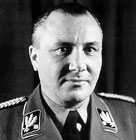
(In Bormann’s office) I didn’t only read (reports); I watched what was going on at Bormann’s desk and his method of work. I gained new insight into the character of that powerful man, feared by many and even hated as the "grey party eminence." During that period he appeared to me more transparent and more understandable than in previous years. I will describe him as I saw him.
Here he was sitting, the so-bedeviled man, with his shirt sleeves rolled up during the high summer heat. With a lively alertness and immense industriousness, he worked through piles of files, dictated and phoned without a break. He had the endurance of a fighting bull. I think Adolf Hitler saw him correctly when he told me once: Bormann is like his signature and that is like the “Höhe Göll.”
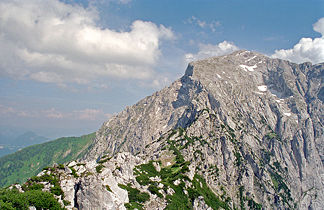
View of the Höhe Göll, a high mountain peak close by the Berghof, Hitlers home.
I was often present at that time when Bormann reported (to Hitler); he did so in a matter-of-fact and concentrated way, with all the pros and cons, mostly about very important matters. Sometimes, when persons and happenings were involved that I was familiar with, I could see how clearly and correctly it had been reported. Then Adolf Hitler decided it. That information given to the Führer covered all areas of the State, the Party and the whole civil sector, and lasted sometimes hours. I was drawing while this went on, but still listened carefully. An adjutant would appear, reporting the ‘Lage.’ Or an interruption because of an established appointment – then Hitler would say: “Giesler, we'll continue later.” Or to Bormann: “See that Giesler gets some refreshments.”
A little later, I was again sitting in my corner, refreshment there, reading the reports or silently watching Bormann at work. He often dictated to two or three secretaries at a time. But – rather strange and surprising – at the same time that Bormann dictated to give the gist of the matter, he memorized Hitler's decisions word for word, following the sentences exactly as they were spoken by Hitler, while in between he shaped the letters and orders that derived from them. Telephone calls came in, disturbing messages were handed to him, after which he continued dictating where he stopped before. Again a call came, Bormann looked at me: “The ‘Lage’ is over, the Führer expects you,” and turned again to his work.
Who could endure that, day in and day out, always deep into the night, and for years? Indeed, Bormann was like the “Höhe Göll” and, like that “Göll,” he sometimes cast a shadow in bright light. Naturally he cast shadows. Sometimes, I had real quarrels with him, or he with me. Twice, Hitler intervened: “Giesler, please go along with Bormann.” Once at the Berghof, Spring 1944, he said to me: “Giesler, if you want to drive away from here early, mad because of Bormann – but you are Mrs. Bormann's guest, and you are also my guest – no, you cannot do that to us! By the way, let it be said to you, in that case Bormann acted absolutely correctly. He naturally should have given you some explanation, what I herewith do now …. Well, see!
"Giesler, I need Bormann and his working strength. He relieves me, he is steady, unshakable and an achiever – I can depend on him!” In retrospect, I always found out on my own that Bormann was correct to get tough on me, or that he acted on Hitler's order.
Bormann noticed everything; it reflected his former job as an estate administrator. I accompanied him once on an inspection trip at the small farm that supplied the Obersalzberg. He checked out everything, down to the champignon cellar – nothing missed his eyes. Then we climbed into the forest above the Berghof area. There he showed me his animal world in its free, natural surroundings. An owl was there, a squirrel – what else was jumping around there I cannot remember. He allowed beehives to be brought in to the “Höhe Göll” when the pine trees were blooming. He got enthusiastic about that magnificent mountain. Dr.Todt had personally searched for that high track and marked it through the sheer rocks – it is the most beautiful and daring road by far. “I hold Dr.Todt in high esteem and still think about him often,” Bormann said.
On the way back, turning off the road, he looked around and asked how I liked it. I remarked one has a wonderful view from here, all around – it’s beautiful up here. “Yes, a good location,” Bormann said. “Connection with the street, which in winter is cleared from snow; a well is close by. You are going to be settled here after the war so you are present for the Führer at any time.” Striding on, he whistled A la mi presente al vostra signori – the old Landsknecht (medieval soldier) song.
During the difficult days in August 1944, when the disloyalty and treason were apparent, Bormann said to me with a very serious meaning: “I have one task and one goal and that is to serve the Führer as a National Socialist. My only ambition is to do that as well as I am able. The Führer gives me the authority which I need to do it. I activate it, but solely for this my task. Certainly, you have no doubts that I am totally obligated to the Führer. I don’t want anything else but to take some of the heavy burden off his shoulders, and that is not easy!” I believed him.
- Printer-friendly version
- 12600 views
Comments (5)
More on Bormann
Finn
Some excerpts from Christa Schroeder's (Hitler's personal secretary 33-45) about Bormann:
"Bormann was simply one of the most devoted and loyal of Hitler's vassals who would often force through ruthlessly and sometimes brutally the orders and directives given by Hitler".
"He was neither hungry for power nor the 'grey eminence' in Hitler's entourage. To my mind he was one of the few National Socialist with clean hands...for he was incorruptible and came down hard on all corruption he discovered".
Hitler on Bormann according to Schroeder:
"Where others need all day, Bormann does it for me in 2 hours, and he never forgets anything!... Bormann's reports are so precisely formulated that I only need to say Yes or No.... If I tell him, remind me of this or that in 6 months, I can rest assured that he will do so".
A little more on Bormann
Finn
From the memoirs of press secretary Otto Dietrich:
"Hitler trusted him right down till the end, recognizing in Bormann a blindly obedient instrument who would pass on and execute his commands without the slightest deviation. In Hitler's will, which bears Bormann's signature as witness, Hitler recommended him to posterity as his 'most loyal comrade'".
From the memoirs of Hitler's personal Friend and photographer Heinrich Hoffmann: in a conversation about a complaint issued to Hitler about orders given by Bormann, Hitler explains:
"Get this quite clear in your own mind...To win this war I have a need of Bormann!.. the fact remains, one after another, everybody has failed in their implicit obedience to my commands- but Bormann, never!...Everyone, I do not care who he may be, must understand clearly this one fact: Whoever is against Bormann is also against the state!".
According to Albert Speer,
Reino Falk
According to Albert Speer, the Führer personally rejected the inscrutable ideas of Alfred Rosenberg and of Heinrich Himmler. But he did not reject them in favor of Christianity, but in favor of the scientific logic of Martin Bormann! I don't question the legitimacy and integrity of Martin Bormann or the manuscripts he supervised. But I do question the accuracy of the English translation. It should be the task of a native German-speaker who is indisputably in Ordnung to translate these manuscripts as accurately as possible in the future.
In his Political Testament, the Führer named Martin Bormann as Party Minister - that is, as his de facto successor as head of the NSDAP! If one blasphemes against Martin Bormann, one blasphemes against the will of the Führer and against National-Socialism.
Heil Bormann!
Speer
Finn
I've been very skeptical of Speer's memoirs for 2 resons: (1) The about-face Speer pulled after the war in regards to his view of Hitler and (2) It is claimed (By Irving) That Speer's memoirs are heavily edited by the publishers.
With that said, yes Hitler did reject the pagainsm, Thule society, cultism...etc along with Christianty... If his spiritual beliefs had to be classified under a category I think it would simply be: Deism.
small correction
carolyn
Not claimed by Irving -- claimed by Speer, which Irving related. But Speer also said that the essence of what expresses in the books is correct.